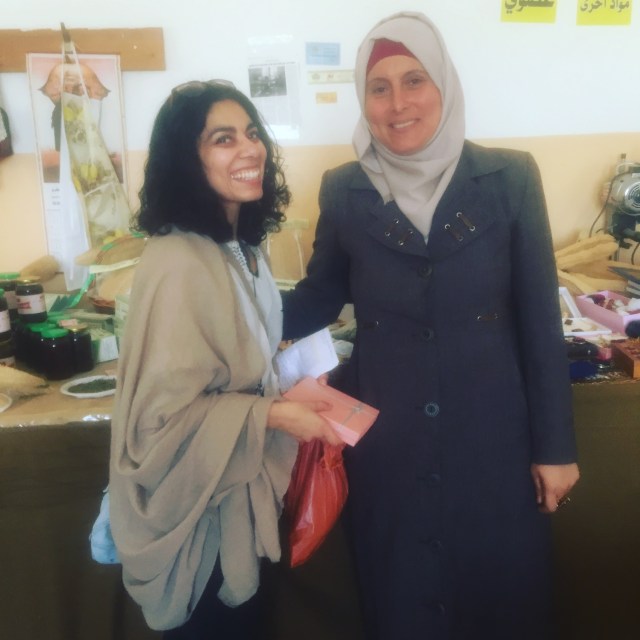
CARE colleague at a project visit to a Women’s Centre in the West Bank
What do you think of when you read the words ‘money is power‘?
Rich tycoons? Celebrity spenders? Men?
Maybe, maybe not. However, for the purposes of this post, let’s assume (and I believe there are solid grounds for such an assumption) that rich, powerful men represent a compelling ‘logo’ for the concept of money being powerful.
This post is about reframing that.
Now, CARE’s work is mainly couched in the language of poverty and injustice. These are far reaching and often misused words. I’ve written before about the way in which the international development sector overuses jargon, and we are still at it.
Within the wide parameters that ‘poverty’ and ‘injustice’ house, CARE delivers humanitarian relief, and we pride ourselves on our long term development interventions. More recently, we have been describing how we build resilience for communities.
There are then a bunch of derivatives used about each of these terms, which I’ll let you research yourself (as I’ve no doubt you now will).
This latest trend towards resilience is, in some ways, an attempt to combine the two historically distinct and typically separate areas of our work – namely, humanitarian relief and longer-term development. Continue reading “Money is Power”→
Paula Atun, a young Filipino entrepreneur living in Calamba City, thought she was filling in an online survey, with her idea on how to catch and filter rainwater. She’d seen the idea on the Discovery Channel.
A few weeks later, CARE Philippines had signed her up as one of their local ‘innovators’, tasked with investing over PHp 1,000,000 ($20,000) into this idea, and leading the production and distribution of it to 15 local households, the inhabitants of which are either elderly or living with disabilities.
Paula had, in fact, inadvertently applied to the Philippines TUKLAS Innovation Labs project. And her idea was eventually chosen as one of forty, shortlisted by CARE Philippines and three NGO partners managing this DFID and Start Network initiative.
The Philippines is the second most disaster prone country in the world, and the objective of TUKLAS is to source ideas from local communities for disaster preparedness. It then instigates a process for funding and building the capacities of local creators and entrepreneurs to pilot or scale these. Continue reading “Innovating against the inevitable”→
Back in 2012, I recall discussions at a Bangkok conference with a group of companies keen to lead the charge on ‘women’s economic empowerment’ in Asia.
On the one hand, there was a business case (mainly linked to profitability and staff retention) for these companies to address gender inequalities more systematically and, on the other, many at the time admitted to jumping on a band wagon – the feeling being that women’s economic empowerment was the new thing that people were talking about, but which perhaps had “5 years at best” before the world moved on to the next hot topic.
Fortunately, in 2017 the same companies are still testing the business case and, as we’ve seen in some sparky media pieces on women’s economic empowerment last week, the topic has far from fizzled out.
I enjoy today’s reality of how one op-ed can turn heads, and stimulate an instant planetary debate. Even if such things can also create a battle cry from one school of thinking to the next, with critiques put out more as literary pitch forks plunged into the sides of the opposition, rather than in the more collegiate spirit of pooling our collective energies around an issue – in this case that of gender justice, the world over.
Maybe the space for collaboration is closing, however, and gloves-off conceptual sparring is more useful in garnering attention and bringing issues of women’s empowerment into the mainstream? There have already been multiple “global” conferences over the past 20 years laying down the development challenges of the day, and so an appetite for hosting more such events is, perhaps, understandably waning.
Furthermore, we have a relatively newly re-framed set of UN Development goals, which were met with broad approval. Our stage is set then, and so, within such institutional parameters, conflicting opinions of course need to be aired.
As much as Rafia Zakaria’s NY Times piece instantly struck a chord with many, so too did Linda Scott’s rebuttal. The first article lambasted the array of economic empowerment approaches deployed by organizations, claiming instead that political reforms are the only show in town in terms of actually bringing about change. The second article made the case for why economic empowerment interventions do have a significant role to play and how they can compliment advocacy and political influencing. I found both of value.
Of course, the development sector has much still to learn and we have our idiosyncrasies. As someone who has worked for an international NGO now for over 11 years, I have often buried my head in my hands at our sector’s insistence in dispersing a daily barrage of loaded and contorted rubric, when articulating the everyday realities of people around the world.
However, I am proud to be associated with an entity such as CARE International that is committed to gender justice. In spite of our sector’s insane vocabulary uses, our commitment can – and always should be – first and foremost about influencing change, rather than turning a profit, or trying to win an election.
‘Empowerment’ is, of course, one of the development industry’s most sacred slices of parlance. Crow-barred into panel discussions, funding proposals, office meeting agenda items: it is our holy grail.
Do we know collectively how to prove when empowerment has been achieved? Not quite.
Are we aligned on how to best facilitate or help create empowerment and how it differs contextually? Not always.
Does any of that matter? I really don’t think it should.
That ‘power’ itself is the currency with which we know change can be bought, the notion of empowering those without it seems to me to be a very practical, core mantra for the likes of CARE.
Like Linda Scott, I believe in the work of the many thousands of agencies who pursue empowerment using different approaches. We know, fundamentally know, that re-balancing gender dynamics has a positive impact on poverty reduction, and on social injustices. There is no need to reinvent this theory or replace it with another. CARE’s economic empowerment experiences have also underscored the very need to place emphasis not just on economic gains for women, but on social and political ones, too.
Absolutely, the international NGO industry needs to operate with transparency – we must be accountable for how we invest our resources into “empowering” initiatives and goals. Largely due to the countless examples of how the world’s governments and multi-national companies regularly get caught up in headline grabbing scandals, watch-dog attention on humanitarian and environmental organisations has been low level. Let’s encourage more: there is always room for improvement and, as an industry, we can’t exist in a complacent vacuum.
However, when approached holistically, comprehensively, and in step with others, the pursuit of women’s economic empowerment outcomes, for the many millions of women currently cut off the grid, made vulnerable and marginalised due to their gender, should be not only encouraged and supported, but should be recognised in terms of a set of human rights which everyone in the world has a role to better understand, shape and nurture.
Her first four children each died of asphyxiation during delivery. The 30 year old’s fifth – a baby girl – was born safely at home, and against all odds. However, when the same expectant mother entered Bihar’s district hospital last Friday, to deliver her sixth baby, she was praying for a boy. She entered the hospital carrying the hopes and dreams of the many family members waiting outside for the news and, as I bore witness to, her prayers were answered.
Through CARE International’s influence within the health sector of Bihar (one of India’s most populated states with 110 million citizens) this mother had been encouraged to deliver her sixth baby in hospital, rather than at home. A decision which instantly improved her and her baby’s chance of survival.
I was visiting the hospital with the local CARE team at the time, to learn more about how CARE is helping transform the state’s healthcare system, and improve the quality of the services available. Continue reading “One born every two seconds”→
I’ve been working in Dili, the capital of Timor-Leste (East Timor) this week, and it’s been a privilege as always to spend time in new surrounds. More so when stationed one hundred metres from the sea, with spectacular daily sunsets, and some of the tastiest coffee money can buy.
Timor is an island, just a short hop north of Darwin, Australia, and up until quite recently, following 500 years of Portuguese occupation, was an Indonesian colony (between 1975 and 1999). The western side of the island is still governed by Indonesia. Timor-Leste claimed its independence in 2002.
Like so many other countries in 2016, Timor-Leste is experiencing the effects of the current El Nino droughts, disrupting the country’s wet season and ruining harvesting potential. A topic covered on this site back in March during my time in Ethiopia.
My assignment this week, however, has been to support CARE’s work to engage more with private sector companies in Timor-Leste (banks, retail, media and others) and examine ways in which, together, initiatives and relationships can be forged to tackle some of the social and economic challenges the country faces – poor infrastructure, lack of employment opportunities, issues around food security and nutrition, financial literacy, to name a few. Even without a more severe El Nino year, Timor-Leste is dealing with all of these mini crises combined. Continue reading “Making change happen: Collaboration, and the power of Storytelling”→
At home with Sindayo, a GRAD beneficiary in Tigray. Photo credit @ CARE Ethiopia.
Last month I visited Tigray, Northern Ethiopia, to interview farmers and livestock traders faced with the drought effects of one of the most devastating El Niños in 50 years, to learn about their coping strategies in the face of extreme weather patterns.
We wanted to find out how these coping strategies were linked to national and international market systems and how, through these systems, it might be possible to bring about a better deal for those in the supply chain typically made more vulnerable by drought: women.
CARE International, the global NGO and my employer for the last decade, has been operating in Ethiopia since 1984, and works alongside other international and national organisations to bring solutions to those whose livelihoods are invested in agriculture, and who by default are affected by regular market “shocks”.
After 70 years of operations around the world, CARE’s focus within any country programme is to bring about positive changes for women and girls. We do this because of the myriad of existing social and economic injustices faced by women and girls, all over the world, many of which have been described on this blog. At CARE, we talk a lot about “empowering” women and girls, and this encompasses many aspects, including improving access to economic resources for women and, crucially, increasing their control over those resources. Continue reading “Resilient Markets in Ethiopia”→
Christmas is coming and there’s no stopping it. Even here in Saigon the Vietnamese have started to embrace what has become an indulgent festival of consumption, celebrating the birth of Jesus Christ.
And, at this time every year, people like me pen blogs like this one, instigated to push a perspective your way. People like me who (you’ll soon enough not be surprised to read) have just spent half my week up in rural Vietnam, meeting local communities.
I’m back on the regional conference circuit at the moment, and it’s awash with talk about “scale” and “impact”.
Sound-bite central, indeed, with events I’ve attended recently also still obsessing with how to achieve scale and impact by working in “partnerships”. As suggested in my last post we need to look beyond semantics in the sustainability arena, and instead get real about what some of these terms actually mean as, all too often, our preoccupation with the vernacular distracts us from action.
The UN’s new Sustainable Development Goals (SDGs) have included “global partnerships” as their 17th Goal. The proof of authenticity around what the UN thinks can be achieved with this Goal will be revealed over time. However, right now, it seems to me that if you are not talking about “scaling your programmes”, or “measuring the impact” of your efforts (in terms of playing a positive role in society) then you are not “on message” – and that, for many, is a public relations cardinal sin. Continue reading ““Scale, impact and partnerships” – seeing through the buzz factor”→
Over the last couple of months I’ve spent time at various “partnership” themed events. Bangkok, Singapore, Hanoi, even the leafy outskirts of Atlanta, Georgia, many thousands of miles away from the hustle bustle of Saigon. Different venues, but similar take-away recommendations about how, if we are truly to tackle social and environment issues and bring about change in the future, for the future, we must join forces with others.
In some cases, forming alliances which might seem oxymoronic: for example, big business in partnership with local communities; municipal governments working with large NGOs.
Previous case studies on this blog site (where CARE is partnering with companies in the region, including GSK and Diageo) are backed up by hundreds more out there, many of which are breaking new ground and offer hope for replicating models which others can adopt, adapt and improve. Continue reading “Partnership musings at 33,000 ft”→
Drawing in the tourists – a Sri Lankan sunset over the Indian Ocean
I have visited Sri Lanka in a work capacity every year for the past five – posting about it just recently on this site – however, this April, I’ll spend my 40th birthday there, as a tourist, on the country’s southern coast.
Post war Sri Lanka (since 2009) has much to offer the increasing number of tourists, flocking to experience white sand beaches, up-country tea plantations, and the joy of some spicy coconut sambol for breakfast.
The hospitality and tourism sector is one upon which Sri Lanka is heavily relying, not only in terms of driving up economic gains for the country, but also in making a positive ripple effect on related social factors – in particular, supporting the employment needs of what equates to several million young Sri Lankans on the look out to secure a job.
Within this context, as well as having the potential to positively tackle youth unemployment in the country, the hospitality and tourism sector is in a position to also address why it is that so many women in the sector are not being supported in their careers – and in some cases, why in the very first instance it is a challenge for women to even enter the workforce. Continue reading “Women’s Empowerment in the Hospitality and Tourism sector”→






 definitelymaybe