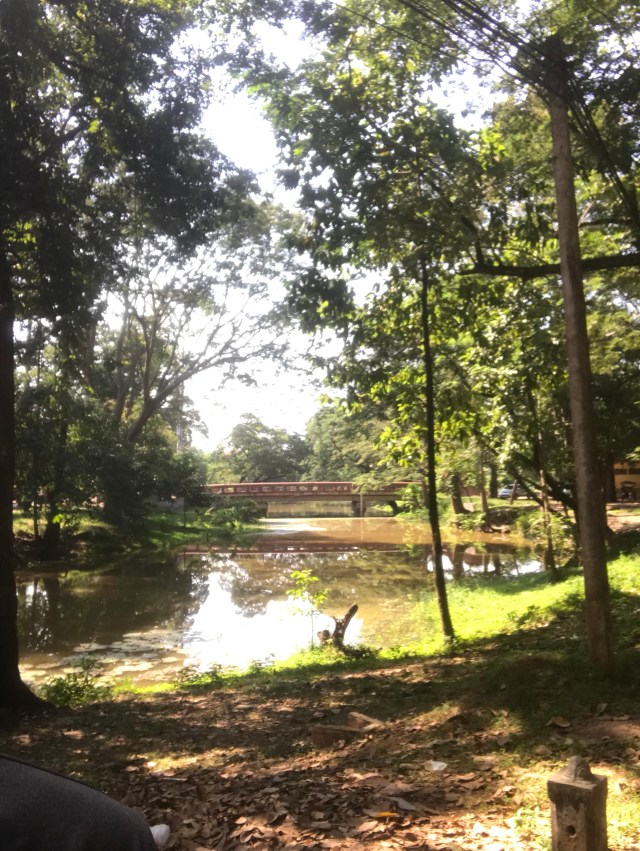
Over the weekend I was in Siam Reap and, for whatever reason, found myself enchanted by the trees and the colours and the red earth. Not in any particular novel way, but in a way that connected to something I may have simply been ignoring for my entire adult life: that simple truth about the fragility of life and changing our own lives whilst we are fortunate enough to be here.
So, you know, I talk a good game and encourage others to do lots (plus I now have one daughter doing her thing to contribute towards lowering the demand for meat) versus I fly 1,000s of miles every year, like a bit of air conditioning in the Saigon heat and probably, on most other climate friendly criteria, would likely score pretty poorly.
And yet, the science on climate change has been public for years now. As much as a decade ago, I remember seeing a campaign in the UK to highlight the effects of climate change on the poorest communities the world over. The strapline’s call to action being: “turn down the thermostat – it’s getting hot over here.” The accompanying picture was of a pastoralist with his herd of livestock, sweltering in the heat of an African savannah.
Wind forward to the most recent round of climate change headlines (momentarily competing on the front pages with the familiar and depressing daily churn and circus) and the news about our warming planet remains bleak. Continue reading “Drawing Down”→
CARE’s Innovation Team working the camera at Goodlight Studio, Birmingham, AL.
This time last week I returned from the USA – a giddy eight flights and two weeks of work and immersion into some of the country’s civil rights history, as CARE contemplates setting up programmes in America.
I’m still absorbing all that I saw and heard…
From talking to activists outside The White House the day after I arrived; to discussions with colleagues in D.C. about CARE’s future presence in Nigeria, where we are aiming to build the resilience of those affected by ongoing humanitarian issues there; through to time in Atlanta with my incredible team, exploring ways to lift up the opportunities for innovation across CARE’s network…
…before pausing for a weekend’s moment of Southern Decadence in New Orleans, a city whose authenticity and openness (in more senses of the word during that particular weekend, and which requires it’s own discreet blog post) to diversity and to humanity really are as creative and appealing as one imagines they could be; followed by road tripping up and into the State of Alabama, for more planning sessions at the fabulous Goodlight Studio in Birmingham, and a whistle-stop dive into some of the iconic civil rights moments of the 1960s, which unfolded in this infamous part of the country (from the 16th Street Baptist Church bombing of 1963, to visiting Joe Mintor’s garden displaying thirty years of work in bringing to life historical events in his garden, through the medium of scrap metal and every day objects)…
…all of which culminated in a final leg in Montgomery, meeting the team at the Equal Justice Institute (EJI) and hearing from Lecia Brooks and Richard Cohen at the Southern Poverty Law Centre, privileged encounters (amongst others had that week with lawyers, journalists, pastors and advocates for change) offering up precious, honest and heart wrenching insights into the social justice journeys that so many generations across the “Deep South” have been experiencing, each story a momentary platform to quench the individual (and increasingly collective) thirst for action which pulsates through the corridors of these justice-focused institutions, and through the determination of those who inhabit them on a daily basis…
…until, with my last 24 hours to spare, I flew up to Connecticut, to spend time with one of my oldest and dearest of friends, whose son, my godson, Sam, and I played pool whilst, trading insights about the speeches of Martin Luther King, taught at Sam’s high school, and equipping him and his peers with knowledge, in a way that left me more inspired about how this next generation of power holders and decision makers, of mothers and fathers, of politicians and business executives, might be gifted the intuitive sense of how their fingerprints and footprints can have positive meaning and a place in future history books, as they embark on their own life missions to become their best selves… Continue reading “Back in This”→
It’s the weekend, and I am up the coast of Vietnam, on An Bang beach, enjoying ocean scenes, blue skies and the lazy movement of palm.
A paradise of sorts.
I brought with me Rebecca Solnit’s A Paradise Built in Hell – a fantastic read: with its insightful and brilliantly constructed chapters, many of which seek to dispel long held preconceptions about what ‘makes us all tick’. And, in particular, how people cope with, are affected by, and grow from the impact of natural and man-made disasters.
I’ll want to quote some of Solnit’s beautiful prose at the end of this blog – for the posterity of one day re-reading this – and I am sure to post again about many of the perspectives her narrative offers up: indeed, my own organization, CARE International, like many of our peers, is heavily invested in learning from our experiences of intervening before, during and after crises.
For now, poolside, and warming my feet on the scorched tiles, this is merely a momentary toe in the water of something I am sure will consume me time and again.
Solnit makes a variety of thought provoking points in her novel.
Some of the most compelling centre around our own philosophizing about what we want to get out of life, how we want to live it, and who we want to live it with? Continue reading “Defining our paradise”→
The genesis for CARE’s emergence into the world begun in the United States of America, in response to the ravages of the Second World War.
CARE brought relief to many countries affected by WW2 through the medium of our infamous “CARE package” – an intervention providing food, water, shelter, and protection to people in need.
Wind forward 73 years, and a high percentage of CARE’s interventions around the world today rely on the same modality, when it comes to getting aid and assistance to those in crisis. We still bring things (hardware, skills, cash) to people who lack the access themselves. Sometimes these can be locally sourced things, but the fact remains that, in many situations, agencies such as CARE are still needed to broker, facilitate and connect.
CARE is not alone in this endeavor. Like many others working in the industry of “aid” we strive to be “first responders” when an emergency breaks. However, CARE also invests in providing sustained support to the increasing number of people affected by protracted crises. In that way, we play both immediate and longer term roles.
I’ve written here about our work in Gaza, by way of an example of this. In Gaza, CARE has experience of assisting communities during times of conflict, and, we simply could not deliver the more ongoing support and assistance to Gazans that we do, were our teams not, themselves, Gazan citizens – living day by day in solidarity alongside those whom CARE is seeking to serve.
When I visited our work there last year, my Gazan colleagues spoke about the 55 day war of 2014, and turning in for bed each evening covering their faces, so as to preserve their dignity if a missile hit their house during the night. In the morning, they would covertly meet with other aid agencies, rocket fire ringing in the air, in order to design how to best support their neighbours.
Like any great pairing, humanitarian relief and longer term development bring out the best in each other. In the Gaza example, CARE is much more knowledgeable and agile in our emergency response because of the nature of our longer term status and operations there.
And so, increasingly, it is being recognized by many INGOs and institutions that there is a space of overlap between these two realms of relief and development, and this overlap has become known as the “Nexus”.
Now, a “Double Nexus” situation describes where relief and development come together. An example of this being a “disaster risk reduction” project which might seek to reduce the impact on a community affected by a cyclone, by establishing upfront an affordable micro-insurance scheme, offering property insurance to small dwellings and poorer communities.
A “Triple Nexus” takes on the third element of ‘conflict’ into this mix, and devises practical ways of intervening in such a way that positively affects not just the resilience of a community, but also the political dynamics in that same context.
All well and good, but what are some of the other frameworks into which we can deploy Double and Triple Nexus work?
Well, The Sustainable Development Goals offer us 17 specific themes that, collectively, frame an answer to addressing societal problems.
Implicit in these, and affirmed by the UN this year, is the reality that the growing number of humanitarian crises in the world today (and highlighted on these pages, too) mean that a higher percentage of the world’s most vulnerable are living in contexts of fragility, conflict, insecurity and grave uncertainty.
We cannot ignore this reality and we cannot continue to deliver aid in the same fashion as we have been doing since 1945.
Secondly, the current push behind the Grand Bargain principles (taken on by donors and NGOs) to invest higher amounts of funding into humanitarian assistance that is locally owned and implemented, is a step forward in how, from a systems perspective, the dial needs to move. Away from cyclical, transactional donor funding and away from siloed programming between emergency relief and longer term development, and towards, instead, a more harmonized way of working across these areas.
These frameworks offer up some core institutional hooks for the likes of CARE, and the good news is that we also have a “proof of concept” – the evidence – that combining approaches and harmonizing our efforts and experiences not only creates opportunities for wider impact, but it saves money.
Early warning systems, micro-insurance schemes, social protection measures – each of these upfront initiatives cost less than those initiatives deployed after an emergency.
CARE’s previous calculations from 2007 were that it cost 7 times more to respond after an emergency stuck, than it did to help prepare communities in advance of events unfolding.
What CARE is committed to is working for generational change and outcomes that go way beyond a single emergency response, but which are informed, qualified and made more robust because of the experience gained from that response.
Ultimately, we want to help create a sustained and enabling environment for marginalized and vulnerable population groups to leverage.
Put another way, we demand a levelled playing ground for all communities, in all contexts, to enjoy the social and economic freedoms and opportunities that many around the world take for granted.
The table where Obama and Bourdain shared a beer and some Vietnamese bun cha
“If I’m an advocate for anything, it’s to move. As far as you can, as much as you can. Across the ocean, or simply across the river. The extent to which you can walk in someone else’s shoes or at least eat their food, it’s a plus for everybody. Open your mind, get up off the couch, move.”
Anthony Bourdain’s words, infectiously honest and, this weekend, hours after he took his own life on Friday, painted all over the internet, a jubilant hat-tip to an affable and engaging character.
It was after a work colleague and her husband (in their home in Dhaka) introduced me to the delights of the cocktail Negroni, that I then stumbled across Bourdain’s youtube advice on how to make one, and I became hooked (both to the drink and to the man).
Bourdain was, in his words, “still dunking French fries at the age of 44” scraping together a livelihood, before the publication of his seminal essay Don’t Eat Before Reading This in The New Yorker, in April 1999, guaranteeing him instant, and ultimately global, popularity.
What I like about his quote above, on the merits of “moving”, is the simplicity of the sentiment, rooted in the instincts Bourdain curated over years of moving around the world himself.
He’d be the first to recognize that not everyone has the luxury of covering as many contexts as he has, but I like that he’s relentlessly stuck to the same message about what he has learned in being constantly on the move. And I think it’s a great message.
Vietnam was one of his more cherished places to visit, too. When Issy and me ever visit Hoi An, we always eat banh mi from the shop – named Phuong’s – made popular by Bourdain, after he sampled one of their banh mis and declared it a “symphony in a sandwich“.
The table in Hanoi, at which he and Barack Obama famously shared bun cha just two years ago, has now been enshrined in a glass cabinet, so proud were the owners of being chosen to host them. And, if you watch some of Bourdain’s documentaries about travelling around the United States, it tends to be a spicy bowl of Vietnamese pho noodles that he goes in search of, on a morning where the hangover is particularly smarting.
In the video above, Bourdain’s unbridled joy at returning to Vietnam and eating street-food turns him into “a giddy, silly foolish man, beyond caring”.
With trademark sign off to his viewers to get out and sample food like this for yourself, his straight-laced take on the everyday importance of community, empathy, humour, and compassion resonated clearly with the millions of people who avidly followed his pursuits from country to country.
**********
It was Milan Kundera, the Czech-born writer who explains in his novel, The Unbearable Lightness of Being, about compassion as having several meanings, depending upon the language origin.
From the Latin, the meaning is “with suffering” whereas, for other variants, the word infers more of the act of “feeling”.
Kundera goes on to state that compassion, taking the Latin derivative, means “we cannot look on coolly as others suffer; or, we sympathize with those who suffer.” For the non-Latin version, “to have compassion (co-feeling) means not only to be able to live with the other’s misfortune but also to feel with him any emotion – joy, anxiety, happiness, pain.”
What Kundera concludes for this second definition of compassion, as a form of feeling, is that it “therefore signifies the maximal capacity of affective imagination, the art of emotional telepathy. In the hierarchy of sentiments, then, it is supreme.”
In Kundera’s novel, his protagonist, Tomas, struggles with a compassion he feels for Tereza (which she “has infected” in him) and it occurs to him that “there is nothing heavier than compassion…not even one’s own pain weighs so heavy as the pain one feels with someone, for someone, a pain intensified by the imagination and prolonged by a hundred echoes”.
In this regard, compassion doesn’t seem like something which would be easy to sustain. In its purest form, it could eventually drive too many emotions round and round your consciousness and your being, that you’d be rendered trapped.
Perhaps a corollary exists here with the compassion that, I think, partly underscores Bourdain’s “open your mind” call to action.
As he moves from one culinary and cultural indulgence to the next, he consistently tells his viewers to use travel and food to gain a different perspective and appreciation of what the world is all about. By extension, he is inviting others into a dynamic whereby they could be susceptible to compassionate feelings for others.
I’m fairly sure that Bourdain’s expectations in doing this weren’t so others would embrace their compassionate inner selves and take on the suffering or the feelings of all those people they meet along the way. However, whilst he knows his shows are entertaining first and foremost, I also feel he does hope to inspire some strain of compassion by sharing his own experiences.
To me, there is some middle ground here. Your movements, your curiosities, your exposure to new things, your ability to actively listen and learn, all of these things leave an indelible mark on who you are. Sometimes this can hurt and other times it produces unfettered joy. Whether it creates compassion specifically in the way that Milan Kundera has analysed the form, or whether a different lens is gifted you through which to view the world, is perhaps less important.
Anthony Bourdain seemed to enjoy living in the present moment – “you only go round once” he exclaims, after his second bite of the Hoi An banh mi. He carried with him an authentic and hearty joie de vivre and a charmingly blunt and down-to-earth swagger, which made his worldly ebullience mesmerizing.
That Bourdain lived a life where roguish enquiry, experimentation, connection and celebration were cornerstones, the darker periods of time to which he was susceptible may also have been mutually reinforcing components to his character.
Of his sudden suicide, more will be revealed. I only hope, as Kundera’s character Tomas felt it “weighing heavy, and prolonged by a hundred echoes”, that Bourdain’s propensity to feel compassion didn’t take hold in such a way, time and again, that its indelible mark was just too much to bear.
CARE staffer Ana Mazen at Azraq camp, in Jordon. Picture credit Sarah Rashdan/CARE.
I’m flying to Singapore on Thursday for work. For those more acquainted with my blogs on definitelymaybe (or on the sister site http://www.saigonsays.com) you’ll have picked up on the fact that I go through spells of heavy travel because of my job.
Every time a work assignment involving being out of Saigon (where I live) is conceived – by me, or by someone I work with, or work for – there are formal criteria for finalizing a decision about going, or not going.
For example, is the assignment in response to a need in that country from a CARE team, an invitation from a partner organization, or the mandate of a higher authority in the system? Who is paying for the costs? What is the detailed scope of work, the objectives? And so on.
I wonder, though, about the less formal criteria that come into play? Those that emanate from individual persuasions and from hierarchies?
Does CARE, and do other entities, in situations of deploying staff overseas to conduct their work, have open and accountable ways of prioritizing who goes where, and for what ends?
Furthermore, how should a not-for-profit agency such as CARE, working to empower marginalized and vulnerable women and girls, decide whether it is more impactful for its mission to send someone in a more “senior” role to a networking conference vs. sending a more “junior” level person on a training course?
In this example, the networking assignment might yield an opportunity to bring valuable new investments into CARE. The training course example might, instead, not only increase the quality of a specific piece of programme design but might also inspire that staff member to be retained for a longer period of time (which, as we know, tends to save organisations money, given the cost of recruiting new people.)
Is one of these examples more directly related to CARE being impactful in our work than the other?
This connundrum, perhaps, doesn’t require public consultation via my blog, and these are issues which are persuasive across sectors and institutions.
However, as carbon emissions are a dominant root cause that exacerbate poverty and social injustice around the world, it does feel incumbent upon those of us working to support those people most impacted on by poverty and social injustices, to be held to account around our standards and decision making.
The issue of how CARE goes about bringing investments into our organisation, how we build quality programmes, and how we reduce our carbon emissions must be inter-connected.
**********
It occurs to me, too, that this use of ‘informal’ criteria is pervasive in all walks of life, and how we make decisions on many things, and speaks to our individual, collective and societal values.
When I ride my motorbike around Saigon (itself an often complex past-time, and one of the topics of an early blog) I’ll make judgements at every corner, and with every mirror check along the way. Split second decisions are calculated based on a.) what I perceive should be the (formal) rules – although it’s never 100% clear over here – and b.) what I might then decide are more intuitive (informal) reasons.
Spread over this recipe for decision making a splattering of social and cultural norms (we got into this last week, too) and sometimes the results are pain free, and other times they leave me hand-gesturing and losing face in front of a road full of people and vehicles.
The values based judgements I and others might be drawing from in such scenarios are often buried deep. And so do we always even know that we are drawing from them, particularly in situations where we find ourselves in arguments or in discussions with conflicting view-points?
I rarely quote the bible on this blog, but how often do we stop and follow the “do unto others as you would have them do unto you” mantra (from Jesus’ Sermon on the Mount, for anyone who, like me, just needed to google the line itself)? If I were to create for myself a strong grouping of values to lead my life by, then I think this one is a great contender.
Yet, is it possible to follow this particular biblical ethic in everything one does in life? Who knows. But I do think a small helping of it everyday would be a valuable beginning.
Just as we are taught (rightly so) not to judge a person by their appearance, I think a good deal of inspiration for me comes when you combine various valuex based sentiments together, and ‘walk their talk’.
As someone initially might take up daily meditation, repeatedly over time they might then develop the ability to use what, eventually, becomes a more ingrained technique and state of mind into how they think, speak, and behave, and how they move from each day-to-day activity and past-time.
Perhaps there is a way for those of us operating from positions of power (from wealth, health, security) to genuinely connect with those values which we often speak about, but less often act upon? Better still, can we be consistently true to these values and be honest with ourselves when we are not?
This morning, I watched a video that actress Shay Mitchell hosted for CARE, documenting a visit she made to a refugee camp in Azraq, Jordon. There, she spent time on a CARE project set up to teach young people how to make films, and give them a channel to express themselves (which I’m pleased to say is an initiative that will now continue through past 2018).
Celebrity promotions of international development work have always been ‘a thing’ and some will be critiqued positively, and some negatively. Carbon emissions were expended, and other investments were made, to make this particular visit, project and resulting video happen. It moved and inspired me (caveating that I do have a certain bias). Maybe for others it will illicit different reactions.
Click on many newspaper front pages this morning, and articles underscoring the desperate plights of hundreds of thousands of other refugees, across the globe, are waiting to be read. They demand, and also deserve, our attention.
This, in part, is our dilemma. I’m sharing the Azraq video to (even slightly) help its promotion to even more then the one million or so watches it has already well deserved. In writing about CARE’s other work from time to time, I hope to do the same. To trigger some reflection. To percolate, for any reader who stops by, a thought or a feeling.
I’ll never actually be able to conclude if this creates impact in itself, but I will continue to experiment with that.
One thing that I do know, specifically related to this video, is that I met Jameel (CARE’s Project Manager for the work in Azraq) recently, and it would be impossible to meet someone whose strong values based approach, to his work and to his life, was more profound.
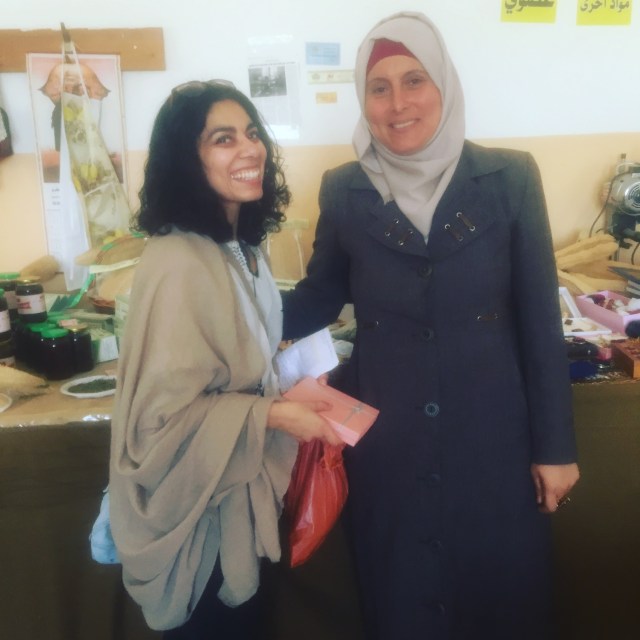
CARE colleague at a project visit to a Women’s Centre in the West Bank
What do you think of when you read the words ‘money is power‘?
Rich tycoons? Celebrity spenders? Men?
Maybe, maybe not. However, for the purposes of this post, let’s assume (and I believe there are solid grounds for such an assumption) that rich, powerful men represent a compelling ‘logo’ for the concept of money being powerful.
This post is about reframing that.
Now, CARE’s work is mainly couched in the language of poverty and injustice. These are far reaching and often misused words. I’ve written before about the way in which the international development sector overuses jargon, and we are still at it.
Within the wide parameters that ‘poverty’ and ‘injustice’ house, CARE delivers humanitarian relief, and we pride ourselves on our long term development interventions. More recently, we have been describing how we build resilience for communities.
There are then a bunch of derivatives used about each of these terms, which I’ll let you research yourself (as I’ve no doubt you now will).
This latest trend towards resilience is, in some ways, an attempt to combine the two historically distinct and typically separate areas of our work – namely, humanitarian relief and longer-term development. Continue reading “Money is Power”→
Local knowledge exchange in Zemalak, Cairo (2016)…….re-visited in 2018
You’ve heard the statistic about the ‘world producing as much information every day as we have in all of humanity’. You maybe read it on Twitter. Or your friend sent you a link to it via WhatsApp. It was probably something like that.
Then there’s the one about our brains only using a small percentage of their capability, and yet we now struggle to absorb more than just bite-sized amounts of news, or information, at any one time.
Sensationalist media headlines fight for our attention in an ever cluttered communications arena. Pictures of Syrian children splattered in blood are up against celebrity scoops, and Trip Advisor adverts mapping our movements and intruding onto our screens and into our lives. The extent to which we depend on, and benefit from, technology is growing exponentially, at the same time as it is eerily replacing so many aspects of our identity, and how and what we fill our waking hours doing.
Do we embrace or reject these advancements? A goose-bump inflection, back to school days of reading Orwell and Huxley, leaves me choosing the latter, and wondering into what flying spaceship fantasy futures my daughters will be subject. Continue reading “Making good in a modern world”→
In silencing those who have been complaining recently that the topic of sexual harassment is currently peppering news editorials the world over, many commentators have rightly couched that this particular metaphorical surface has only just been scratched.
With each new industry’s public acceptance (and condemnation) of the prevalence of sexual harassment, endemic across their own sectoral landscape, others trivialize the issue, committed it seems to end their days affixed to a depth of denial that even your average canary would shy away from examining…
The gods were indeed having their fun with us mortals to take away the life of Christopher Hitchens, while the caustic barbs of his brother, Peter, run free to propagate so vile a perspective on the topic as they did yesterday that even the Game of Thrones’ own Ramsey Bolton would have taken umbridge.
“The welfare system is about to melt down. And you think the most important thing in your lives is a hunt for long-ago cases of wandering hands, or tellers of coarse jokes?”
And there it is, ladies and gentleman, served up on a plate, a steaming pudding of an indictment, reflecting far too many men’s dismissive attitudes when it comes to sexual harassment. Water under the bridge. Generations of despair and psychological trauma conveniently swept, like human dust particles, under society’s all forgiving moral carpet.
Even by Hitchens’ low-bar standard, yesterday’s article is tour de force material.
As if taking on the mind-set of a man whose lost his worldy possessions at a game of poker, and is being escorted out the door, our protagonist flails and raves at the page. Billions of women enduring lifetimes of objectification? I’ll see your bet, and raise you with a rant about what’s really important, which is that our country is “wobbling on the precipice of bankruptcy”.
Is this the same country who voted to leave the economic safety of Europe, and where corporations, politicians and the country’s own Monarchhave spent decades mastering the art of tax avoidance, Peter? If so, maybe take your infantile vitriol out on them.
However, not content with a simple down-grading of sexual harassment in the face of economic meltdowns, our gambling stooge persists.
With one foot out of the casino, and a bouncer’s hand on his shoulder, he can’t resist: “In our post-marriage free-for-all, why should we expect either sex to be restrained? All that’s left is the police or the public pillory of Twitter.”
According to this veritable shitbag of a human being, ever since gender equality started making strides, and the sacred institution of marriage was questioned, society has nose dived.
466 words in, and I’m annoyed that this man has so riled me that I’ve written this (and I apologise for that to the three people who might actually read this blog).
So, let me make a simple recommendation. Boycott this red top propaganda. Boycott the likes of Hitchens, and his poisonous opinions. Boycott Paul Dacre’s lewd, bigoted and fearful curating of these toxic publications. Boycott them all.
Whatever it takes to ensure sexual harassment does not remain a topic analysed only at the surface level, and then filed under a “not that important” index, needs to be done. Those who have committed sexual harassment, whether 80 years ago, should face up to that and pay a penalty. In the public eye, or the private one.
And, all I know, is that there is not one single syllable to be found in yesterday’s vomit inducing Hitchens heckle that will ensure any positive or supportive progress is made in that direction.
Back in 2012, I recall discussions at a Bangkok conference with a group of companies keen to lead the charge on ‘women’s economic empowerment’ in Asia.
On the one hand, there was a business case (mainly linked to profitability and staff retention) for these companies to address gender inequalities more systematically and, on the other, many at the time admitted to jumping on a band wagon – the feeling being that women’s economic empowerment was the new thing that people were talking about, but which perhaps had “5 years at best” before the world moved on to the next hot topic.
Fortunately, in 2017 the same companies are still testing the business case and, as we’ve seen in some sparky media pieces on women’s economic empowerment last week, the topic has far from fizzled out.
I enjoy today’s reality of how one op-ed can turn heads, and stimulate an instant planetary debate. Even if such things can also create a battle cry from one school of thinking to the next, with critiques put out more as literary pitch forks plunged into the sides of the opposition, rather than in the more collegiate spirit of pooling our collective energies around an issue – in this case that of gender justice, the world over.
Maybe the space for collaboration is closing, however, and gloves-off conceptual sparring is more useful in garnering attention and bringing issues of women’s empowerment into the mainstream? There have already been multiple “global” conferences over the past 20 years laying down the development challenges of the day, and so an appetite for hosting more such events is, perhaps, understandably waning.
Furthermore, we have a relatively newly re-framed set of UN Development goals, which were met with broad approval. Our stage is set then, and so, within such institutional parameters, conflicting opinions of course need to be aired.
As much as Rafia Zakaria’s NY Times piece instantly struck a chord with many, so too did Linda Scott’s rebuttal. The first article lambasted the array of economic empowerment approaches deployed by organizations, claiming instead that political reforms are the only show in town in terms of actually bringing about change. The second article made the case for why economic empowerment interventions do have a significant role to play and how they can compliment advocacy and political influencing. I found both of value.
Of course, the development sector has much still to learn and we have our idiosyncrasies. As someone who has worked for an international NGO now for over 11 years, I have often buried my head in my hands at our sector’s insistence in dispersing a daily barrage of loaded and contorted rubric, when articulating the everyday realities of people around the world.
However, I am proud to be associated with an entity such as CARE International that is committed to gender justice. In spite of our sector’s insane vocabulary uses, our commitment can – and always should be – first and foremost about influencing change, rather than turning a profit, or trying to win an election.
‘Empowerment’ is, of course, one of the development industry’s most sacred slices of parlance. Crow-barred into panel discussions, funding proposals, office meeting agenda items: it is our holy grail.
Do we know collectively how to prove when empowerment has been achieved? Not quite.
Are we aligned on how to best facilitate or help create empowerment and how it differs contextually? Not always.
Does any of that matter? I really don’t think it should.
That ‘power’ itself is the currency with which we know change can be bought, the notion of empowering those without it seems to me to be a very practical, core mantra for the likes of CARE.
Like Linda Scott, I believe in the work of the many thousands of agencies who pursue empowerment using different approaches. We know, fundamentally know, that re-balancing gender dynamics has a positive impact on poverty reduction, and on social injustices. There is no need to reinvent this theory or replace it with another. CARE’s economic empowerment experiences have also underscored the very need to place emphasis not just on economic gains for women, but on social and political ones, too.
Absolutely, the international NGO industry needs to operate with transparency – we must be accountable for how we invest our resources into “empowering” initiatives and goals. Largely due to the countless examples of how the world’s governments and multi-national companies regularly get caught up in headline grabbing scandals, watch-dog attention on humanitarian and environmental organisations has been low level. Let’s encourage more: there is always room for improvement and, as an industry, we can’t exist in a complacent vacuum.
However, when approached holistically, comprehensively, and in step with others, the pursuit of women’s economic empowerment outcomes, for the many millions of women currently cut off the grid, made vulnerable and marginalised due to their gender, should be not only encouraged and supported, but should be recognised in terms of a set of human rights which everyone in the world has a role to better understand, shape and nurture.






 definitelymaybe