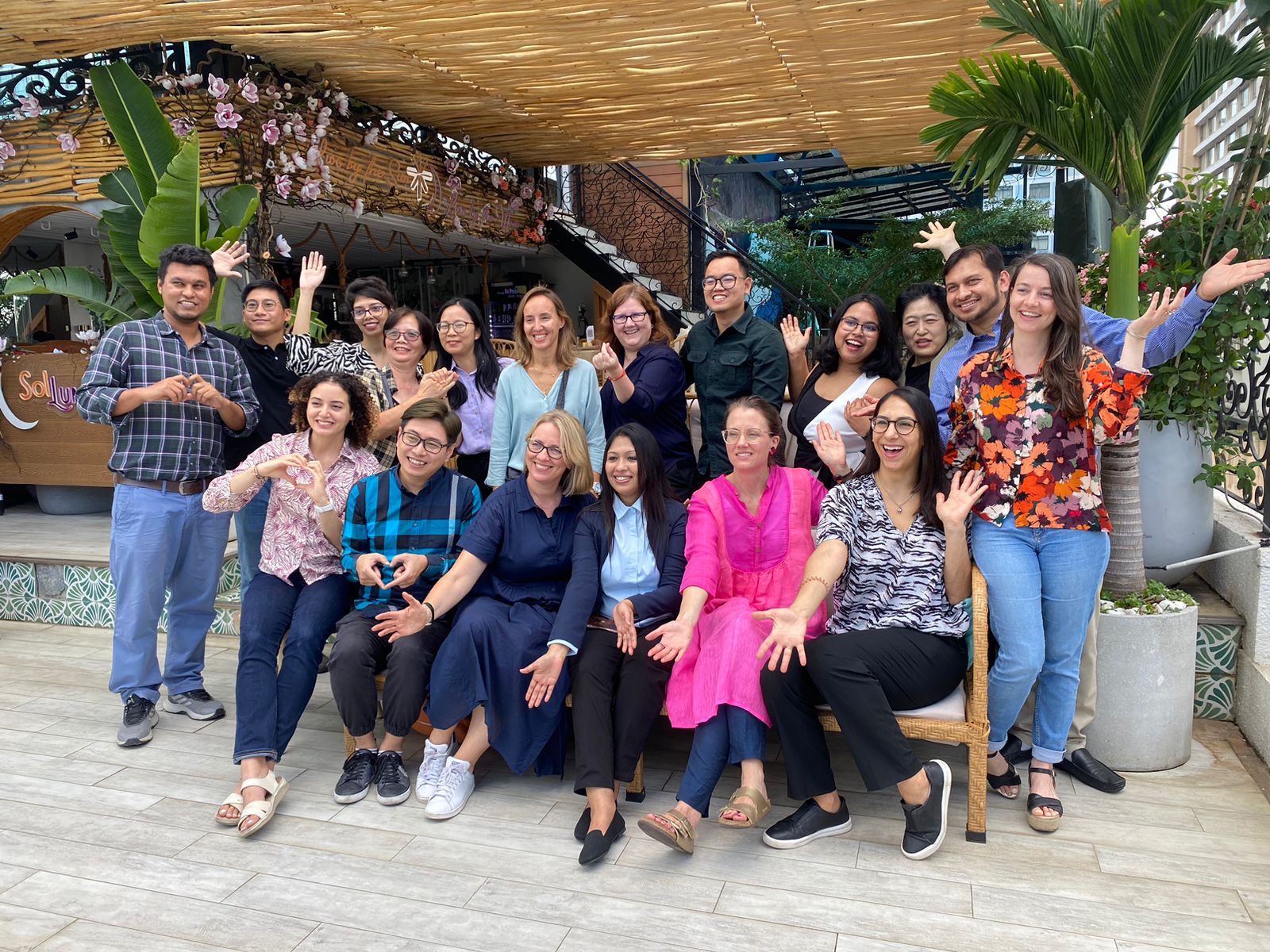
This week I’ve been working with a global organisation, RISE, that is seeking an end to the oppressive conditions faced by female workers in the garment industry. In the very same week we have seen Iceland, which consistently ranks as one of the world’s most progressive nations, convene a nationwide strike (that included their own Prime Minister) demanding equal pay for women.
This, in itself, should speak volumes to the task in hand for the RISE team.
RISE is a newly established start-up of just twenty people but representing the experience and learning of over a quarter of a century’s worth of engagement in the readymade garment sector, by RISE’s founding partners, to improve the conditions for workers. RISE launched on International Women’s Day, in March 2023, the culmination of several years of planning and investment by Business for Social Responsibility, CARE International, the International Labour Organisation, and Gap Inc.
As a collection of very large and diverse organisations, all offering resources and technical support to addressing gender inequities in an industry that employs 60 million female workers, these founding partners have coalesced around the need not only to collaborate, but to go one step further, and to actually join forces and handover the reins of this colossal objective to a single entity.
In taking on that mantel, RISE has a head start on most start-ups, given the vast intellectual property and knowledge it is able to draw on from each of its founding partners.
The twist, of course, is that the journey ahead, in achieving any sort of equity for female garment workers (given the disparities which exist in a country such as Iceland) is a long one. As so many of the RISE team themselves already know from their own experiences, the path ahead will also be fraught with many complex challenges. Not least is the issue of garnering attention from all of the necessary stakeholders – brands, suppliers, factory owners, governments, consumers, the media and so on – who hold sway over worker conditions, on a topic that no single country of the world has managed, yet, to resolve.
What I saw in Saigon over the past three days, however, in terms of the commitment RISE is making through its incredibly dedicated and specialist team, was inspiring.
In just 7 months, this team has already achieved the goals set by its Board – on programme design, fund raising, communications, and on the overall operations challenge of fusing four different organisation’s strategies into one. In this same span of time the team has grown fast – 37% of them joined over the past few months, and many of the longer term BSR staff involved over the past 4-5 years during the set-up phase for RISE, were meeting in-person for the first time in Vietnam this week.
RISE is already delivering programmes for factory workers in multiple countries, here in Asia, but also in the Middle East and East Africa. They are led by inspiring colleagues, who have dedicated large parts of their own lives and careers to the cause, from North America and Europe across to North Africa, South and Southeast Asia, as well as from China’s mainland.
And I commend whole-heartedly, to anyone interested in this agenda, the spirit and passion I saw in the values, behaviours and actions of the team, both as they set about discussing strategic plans, but also as they spent time forming and learning more about one another.
As the American Anthropologist, Margaret Mead, famously said: “Never believe that a few caring people can’t change the world. For, indeed, that’s all who ever have.”
I look forward to following the successes of RISE in the years to come.
I read two things last week, coincidentally connected.
The first was a report from CARE International, offering insights about the impact COVID-19 has had on the local community groups that CARE has been seeking to support for decades.
I commend this report to anyone with an interest in the topic of international development. The analysis is rigorous, yet the recommendations are simple. The tone is calm, but unsettling, given the evidence being shared, which points not to the successes of the international development community, but instead underscores its failures.
It cites how impactful the pandemic has been, in terms of increasing, rather than decreasing, gender inequalities.
It also proposes that far too much potential progress in development is “held back by the deeply colonial approaches” still adopted by global development organisations, including CARE themselves.
Sifting through social media feeds, I then stumbled upon this quote from the novelist and cultural critic, James Baldwin:
“The entire purpose of society is to create a bulwark against the inner and the outer chaos, in order to make life bearable and to keep the human race alive. And it is absolutely inevitable that when a tradition has been evolved, whatever the tradition is, the people, in general, will suppose it to have existed from before the beginning of time and will be most unwilling and indeed unable to conceive of any changes in it. They do not know how they will live without those traditions that have given them their identity. Their reaction, when it is suggested that they can or that they must, is panic… And a higher level of consciousness among the people is the only hope we have, now or in the future, of minimizing human damage.”
Drawing these two “things” together (CARE’s report and Baldwin’s musings) doesn’t take a considerable amount of effort: the traditions to which Baldwin refers, are part of the very reason that international development has failed. The traditions that dictate the colonial influences over how aid has been invested, coupled with the traditions which set the social and cultural constructs that exist on the side of the recipients of that aid, create a perfect storm of incompatibility.
For sure, there are examples of success, and I have spent time on these pages promoting them.
Unfortunately, these are overshadowed by examples of failure, and worse: examples of repeatedly making the same mistakes over and again.
In 1948, the United States committed to the rehabilitation of Western Europe, kicking off the “Marshall Plan” as an investment to help countries after the War.
Many of the recipient countries of the Marshall Plan – Britain, France, Netherlands, Belgium, West Germany and Norway – had, themselves, previous experience of providing aid to countries years before.
Foreign assistance, as a concept, had been around since the 18th century. However, since that time, the majority of the assistance given was from countries such as Britain and France, and predominantly to their respective colonies.
To recap, hastily, on how development has evolved since 1948, organisations (such as CARE International) have invested significant time and energy trying to understand how to most appropriately and effectively assist those “living in poverty”.
Those last three words are in speech marks, because defining who beneficiaries actually are has, itself, been a 75-year exercise.
The World Bank annually grade country demographics and, historically, many aid organisations and government donors use this guidance to allocate funds. Which is why more recently South American countries and now South East Asian ones, are receiving less “aid” due to how they have slowly climbed the World Bank rankings, moving from “low income” to “medium income” economies.
Using economic indicators such as these, some development agencies have prioritised the “extreme poor” as a target group for receiving aid.
Whilst others have nuanced their criteria for “poverty” and zoomed in on defining groups of people based on how “vulnerable” or “marginalised” they might be, which then takes into account criteria beyond income.
Over time, and as the international development industry has expanded, more types of people in need are included, in some way, by some organisation, or movement.
In any case, whilst they have been undertaking their deep dive analyses, and designing their ever-complex programmes, these organisations have encountered a slew of cultural and social normative behaviours (again, Baldwin’s ‘traditions’ – to which each community they are assisting is bound and, from which each community is so heavily defined.
For CARE, the gendered aspects of such cultural traditions – whereby men typically dominate decision making and hold the majority of power over women (at home, in the workplace, and in public spaces) – has become the lynchpin around which all of CARE’s efforts have been inspired.
For others, UNICEF or Plan International, for example, their research and development has anchored itself to the challenges that children or young people, respectively, face in society.
Uganda, 2016. Photo credit: Tim Bishop
As many commentators have cited, the evolution of “aid” over the last 200 years has charted a meandering course, undergoing regular modifications.
Take the topic of financing, for example.
Many nations, and large development organisations, have explored what might be the most efficient financial instruments they can deploy: Government-to-Government loans; microfinance programmes; economic stimulus packages; public-private funded initiatives, designed to strengthen economies and improve societal issues.
Each of these examples, come with their own success stories however, without exception, each encountered this same obstacle of tradition on both sides of the equation: the traditional norms set by those investing funds and resources into development, and the traditional norms played out by those receiving the financial “help”.
Given these constraints, it is simply not clear, even today, what types of interventions are best and how these should be delivered.
Is it more appropriate, for example, to stimulate economic growth for a country or, instead, better to understand upfront what is needed by those in that country who are struggling financially and who are excluded from formal systems (ie they lack access to bank accounts, internet, markets, education, etc) and to design an intervention that addresses that need?
Both of these approaches have been tried and tested and, in some cases, combined. However, again, traditional norms create obstacles along the way.
For example, direct budgetary support (a financial transaction between Governments) was, for a while, a popular choice of many richer nations to financially support poorer ones. Yet, this type of support could be all too often undermined by recipient Governments not properly distributing the funds through public services. Instead, many would funnel disproportionate amounts into other areas, such as to the bank accounts of Government officials.
And, when it comes to implementing the second approach (ie answering the “needs” question) this, too, can be compromised by the nature of who makes decisions in society, writ large.
Not exclusively, but typically, all such development-based transactions, and development-based relationships in the past were led by men.
The result of which is that less consideration, over seven decades of international development, has categorically been attributed to those societal issues that would have been selected by women. Women simply haven’t had the opportunity to have an equal voice in conversations about international development in that time. Not in the initial orchestration of The Marshall Plan, nor in the decisions with, and within, communities in terms of where and how the resources should be utilised.
A Village Savings and Loans Association meeting in Tigray, Ethiopia, 2016. Photo credit: Tim Bishop
It was CARE who established the first ever Village Savings and Loans Association (VSLA) in Niger in 1991, a mechanism for women to save and loan money with one another.
This, in turn, inspired the scale up of VSLA platforms around the world, adopted by other organisations too, encouraging women to have a voice inside of communities, and ultimately enabling women to speak out and influence local structures and systems.
VSLAs are one example of how this acutely gendered dynamic and imbalance is shifting. Unfortunately, the pace of change is slow.
Take the issue of unpaid care. This remains a pertinent topic even in the most “progressive” of societies. In the world of business, equal pay and worker benefits are also not yet level for all employees. For many nations, their politicians and leaders have been, and in many cases remain to be, male dominated. As of 2021, only 1 in 5 ministerial positions globally were held by women and, even today, just 17 countries have a woman Head of State, and 19 countries have a woman Head of Government.
These stark ratios are reflected, too, at the local level of the majority of countries – in the political and public spaces of local authorities and community leaders, in small to medium enterprises and local businesses. The patterns are similar, the outcomes the same.
And, whilst today’s inter-connected world has increasingly called out these gender imbalances, in a way that simply wasn’t viable even 20 years ago, Baldwin’s intuition when he writes “They do not know how they will live without those traditions that have given them their identity” rings true.
Just as traditional norms hold back gender equality, so too do they stifle advancements made around other forms of inequality.
More than ever, we have been made aware of the economic inequalities of the world – the “1%” phenomenon.
Every country maintains its own version of this and, globally, it would seem that the ratios of the ‘haves’ and the ‘have nots’ become ever more extreme with each annual set of data released.
According to last year’s World Inequality Report, “Global wealth inequalities are even more pronounced than income inequalities. The poorest half of the global population barely owns any wealth at all, possessing just 2% of the total. In contrast, the richest 10% of the global population own 76% of all wealth.”
Armed with such data, it is hard not to side with those campaigning for change. Be that from an accountability perspective, lobbying for more responsible policies and practices adopted by business and by government institutions. Or be it from a more ethical perspective, targeting individual behaviours.
Both make sense, yet both have their limitations when it comes to just how much ground individuals, corporations, or governments, are prepared to concede at their own expense.
With power comes responsibility, and all too often that responsibility lies in the shadow of a tradition that is extremely hard to change.
Whether you set your sights on tackling inequality, poverty, vulnerability, marginalisation, gender equity, disability, child rights, or other such societal issues, I would argue that Baldwin’s plea for a “higher level of consciousness” remains, simultaneously, a sobering as well as a viable salvation, when redressing some sort of balance in the world.
Although I was tempted to end this post conceding that Baldwin’s call to action might never be fulfilled, instead I would suggest that the subject of ‘consciousness’ gains more traction with each generation.
What if we kept a higher level of consciousness close to heart, and nurtured that sense of what it can mean each day? What if we tried to imbue Baldwin’s words and sentiment into as many interactions, thoughts, exchanges and relationships that we could accommodate?
Do this, and perhaps there may yet come a time where our connectivity with one another sets in train a new sense of what tradition is, what it stands for, and what new outcomes it might reveal.
Last week I co-facilitated a training course for UNESCAP (the UN’s Economic and Social Commission for Asia and the Pacific) at the UN headquarters in Bangkok.
This is noteworthy (and the cause of my first post here since May last year) largely because it represents only the second overseas trip I’ve made for work, since I high tailed it out of Laos in March 2020, with hours to spare, before the Vietnamese border police would have had me detained for a fortnight.
Whilst narrowly avoiding being barred for tampering with UN tech equipment in our set up last week (as well as encountering a curious number of delegates who tried to infiltrate our course) the days spent with the 20 participants enrolled on the training was a real privilege, and a further reason for sharing some reflections here.
The course itself – The Partnering Initiative (TPI) Partnership Accelerator – was a distilled version of a longer set of modules that I’d been conducting online, during the pandemic, as an associate of TPI. In engaging previous teams in the content, from international NGOs, through to large corporations, and UN agencies themselves, I’ve come to acknowledge that TPI’s curriculum offers up a comprehensive and water-tight set of insights and tools, to equip most would-be partnership experts out there looking to forge, manage and scale up multi-stakeholder initiatives and collaborations.
Built into our sessions in Bangkok was more than a smattering of theory and frameworks, about how to get the best out of your partnerships, alongside practical exercises and role plays, designed to allow teams to practice such things as negotiation skills, trust building, and experiencing alternative power dynamics.
Last week’s participants had gone through a lengthy application process in order to participate and then, in most cases, had also gone through lengthy journeys from various SIDS (Small Island Development States) in order to physically show up in Thailand.
Fiji, Mauritius, Seychelles, Palau, Kiribati, New Caledonia, Solomon Islands, Papua New Guinea and Timor-Leste were all represented in some form, during our two days – a constellation of countries covering some of the planet’s most diverse and distributed societal eco-systems.
There are 58 SIDS in total, and one of the resounding pieces of encouragement, that I took away from those engaged in last week’s training, was the appetite and energies they told us their country’s young people felt about the array of sustainability issues that the UN, and others, have carved out across the existing SDGs (Sustainable Development Goals).
I was struck not just by the talent and inputs and experiences shared in the room during our course, but by how motivated each participant was to take their knowledge and learning from the course back to their home countries and to disseminate this wider.
Young people, it was made clear, either still studying, or launching their careers in SIDS, hold the key, in so many ways, to unlocking and unleashing the real power that true partnership-working possesses, when it comes to addressing the world’s most pertinent of social and environmental crises.
All too often, cultural and historical norms predominantly practiced by older generations, hold back progress in society. Progress, for example, towards enabling more girls to have access to education. Progress towards offering more inclusive opportunities for local communities to benefit from national and international supply chains. Towards a future where land rights are equally distributed and acknowledged, where political spaces incorporate more voices from those all too often marginalised, where the resources and the influence of the private sector are leveraged in a more equitable way, namely one which benefits the world’s informal economies.
These outcomes, and many more, were the talk of our sessions in Bangkok, and these issues deserve more airtime beyond a brief training course.
From our participants last week we heard that these are issues which should be built more rigorously into school curricula. Their importance is such that we cannot rely on those in current positions of power, set as they often are in their own ways, and blinkered to emerging societal trends, to be the “changemakers” or the “catalysts of change” that they so often label themselves.
It is young people, either of school or university age, or of working age, with whom these issues most resonate.
Tomorrow’s leaders will carry the can for many of the mistakes made since the concept of “partnership” was broadly incorporated into development jargon. Some people in development circles will say partnerships have always been around, but it was, perhaps, only really at the UN’s 1992 Rio Conference on Environment and Development that the concept of multi-stakeholder partnerships was first coined in a serious way.
In the 30 years since, we’ve seen some admirable attempts to model partnership working. However, we’re just skimming the surface of what I believe can be achieved.
TPI have been hard at it, consulting, designing, sharing and teaching thousands of practitioners since they took on this gauntlet almost 20 years ago. I admire them for that, and for what they have carved out in this space. They are leading the charge.
It is, however, in the hands of the younger generation, in my opinion, where we should be increasingly targeting investments, resources and opportunities to build even wider and deeper the ‘know-how’ about what partnering can achieve, and how it can be done even better. And, on a scale that we’ve never seen before.
In the international development sector, it’s commonplace to read about “systems change”. This is a broad objective. There are many different types of systems in the world, and many ways to change them. There’s a system for how banks distribute money, and how utility companies manage the flow of clean water to households. A system for how to hold your government to account on social welfare measures. A system, more culturally nuanced, for how families inherit assets. A system for addressing global health pandemics. And so on. Millions of systems and ways to both disrupt them and to improve them.
Typically, the INGO industry champions those citizens directly facing marginalisation, vulnerability and injustice. At CARE International, where I spent thirteen years, the target group supported are women and girls. One particular area of focus that I worked on was how to bring the potential of businesses and markets to bear, for the women and girls CARE sought to assist. Many of you have been subjected to years of my posting here, on related experiences from this starting objective. For which I am most grateful.
Having recently completed a consulting assignment with a very special CARE team, based in Palestine, we’ve published a ‘Compendium‘ for those practitioners in the sector who are looking at systems change in the context of fragility and crisis. Better still, for practitioners who are also advancing their engagement with the private sector and their women’s economic development efforts.
The Compendium is titled “Resilient Market Systems” because its goal is to influence not just the economic opportunities for women and girls (enhancing their resilience to economic fluctuations) who are faced with crisis situations, but to improve the resiliency of the wider market systems, themselves impacted by the same crisis.
2020 has also produced Covid-19, a merciless ‘crisis’ that has touched the lives of everyone, and which calls for organisations to pull together. Enabling more ‘resilient market systems’ is clearly not an overnight project, nor something that CARE can do without collaborating with others. However, as a global confederation with a strong cadre of practitioners working in some of the world’s most complex crisis contexts, just aligning CARE’s own teams can be a challenge in itself.
In many ways, this Compendium is a call to action to us all to think about our own role in the market systems within which we operate.
What is a market system? Well, at the heart a market system (captured in the schematic below) exists goods and services value chains, running from production to consumption, and linking up national, regional and global markets. From essential services (eg banking or health) to the production of a range of consumable goods, the roles of the many stakeholders that participate in this chain, who are affected by each of the various external environmental, political and societal influences, are all inter-related.
CARE’s work sets out to trigger a range of improvements that make crisis affected market systems more resilient, inclusive, and profitable in such a way that addresses the previous inequalities which prevented women from benefiting from markets on the same footing as men.
The Compendium aims to help practitioners think through how to do this. From the type of analysis at the beginning of planning the work, through to considerations of how the work will transform gender dynamics favourably for women, to the ways in which the private sector can be engaged, through to how to test people’s resiliency to dynamic economic change.
I commend the concepts behind this publication, and the range of experiences and case studies (ten of which are featured in the Annexes) contained inside. Not just for the more technical components to the document, but because of the nature of how the contents and the spirit behind the work was conceived. Drawing from across the Middle East and North Africa region – countries including Palestine, Turkey and the Caucasus featuring prominently – but also wider, this Compendium walks the talk of how a large confederation such as CARE should be working collegiality across its teams, diversifying its thought leadership in the pursuit of the right solutions, for those most in need of them.
Aside from the plausible accusations that the Government’s merging this week of the Department for International Development (DfID) with the Foreign Office was a “media stunt” to distract away from their U-turn earlier in the day on free school meals, the announcement about DfID was depressingly predictable, and in-step with an administration, yet again, talking about their vision for “change” but acting in ways that only serve to drag the country backwards.
I’ve plenty of disparagement to channel at both Labour and Conservative leaderships over the last 20 years. However, under Claire Short for the first six years of Tony Blair’s Government, in my opinion we experienced a conviction and clarity about the role of DfID that has since to be matched.
Blair’s re-branding and re-positioning of DfID (previously the ‘Overseas Development Administration’) as having full departmental status, complete with a Secretary of State was, in itself, a turning point.
During her tenure, Short had plenty of critics, however a cornerstone outcome of these early years with her at the helm was the Partnership Programme Agreement (PPA). The PPA was a multi-million pound investment from DfID that was used to leverage their relationships with British INGOs (International Non-Government Organisations) – including CARE International, for whom I worked from 2006.
From first hand experience, I saw how effective these funds were for INGOs looking to build the capacities of their teams around the world and, in doing that, mobilising local community based organisations.
The PPA covered Latin America to Sub-Saharan Africa, the Middle East, South and East Asia, all the way to Vanuatu in the Pacific and funding wasn’t “restricted” – the term used by institutional donors which means money is earmarked only to be spent on certain items. Instead, it was more simply a requirement that funds complemented DfID’s priority areas of work – which initially included: conflict and peace building; women’s economic development; governance; and private sector engagement.
Following the Iraq invasion in 2003, and the Asian Tsunami in December 2004 and then, indeed, throughout the period I was based in London (from 2006 to 2011) DfID consistently updated the issues and geographies they felt to be of prime importance.
As DfID’s global coverage was reviewed under Cameron’s team from 2010, offices in Latin America closed first, deemed predominantly a region consisting of “middle-income” status countries and less in need of traditional aid. South East Asia was next (they closed their Vietnam office in 2016) and overall the nature of PPA funding and how it used was dictated by other criteria.
From here on it felt like DfID was re-purposed all over again. Whilst Cameron was committed to DfID receiving and spending 0.7% of GDP (the magical figure to which very few donor countries have aspired) he introduced an annual “value for money” evaluator which held back funds until organisations could prove they had delivered results on the ground.
On the one hand, he was calling out agencies on being more accountable (as well as trying to keep Daily Mail readers charmed for polling days, given the rising outrage propagated by the “Red Tops” about British aid money being sent to countries such as India – a nation with 350 million people living on less than one dollar a day, but also housing a nascent space programme).
On the other hand, it is ludicrous to measure meaningful change taking place in under twelve months. At the time, the previous 7-8 years of PPA funded work was only just on the verge of being able to quantify ways in which programmes had addressed gender norms, let alone to have fully rehabilitated a state such as Tamil Nadu, which had been destroyed during the Tsunami.
And so, in place of a more open, thoughtful and practical distribution of funds, through mechanisms like the PPA, the Tories instead focused on trade issues, on supporting ex-commonwealth countries (in particular Kenya, which hosted regular delegations of Ministers and their wives) and on gradually reducing the amount of money they were prepared to invest in partnerships with INGOs.
I don’t feel qualified to mention the fine balance – always there – with which the British Government has forever had to deal with being one of the largest manufacturers and suppliers of high grade military weapons the world over, whilst at the same time being held up as a beacon of ‘know-how’ when it comes to their work on social injustice, poverty and inequality. Go figure. Perhaps that is for another blog.
What I do know is that, within that complex backdrop, DfID had many very progressive years of designing a new approach, and a more appropriate role for itself and for its international ambassadors, be they individuals or partner organisations.
Johnson and Co. have just rendered that progress irrelevant with this merger. Just as the Australians have done with their previous international development arm, now part of the Department of Foreign Affairs and Trade (DFAT), in the process slashing millions of previously sacred aid money. Not that dissimilar too, to the stance taken by Donald Trump since he took office, and cut the legs off the US Government’s aid department (USAID) budgets.
These power-plays are related. They smack of Governments losing the foresight and the global citizenship credentials required to sit at some of the world’s most important decision making tables.
The DfID merger is sending the UK back in time – a core characteristic of the Johnson administration on many fronts – and it’s a terrible, terrible shame.
Thanks to technology, we have all kinds of information at the click of a button. Whilst huge numbers of population groups can’t access the internet, not long from now everyone will be connected in some shape or form.
Technology is helping us make better sense of our impacts on the environment, and how to resolve the negative aspects of these. Technology has enabled block chain systems to evolve, challenging how existing global market transactions work, and providing alternative methods for citizens to cast votes in elections. Technology is enhancing the way we communicate with each other, how we forge and maintain relationships, both professional and personal.
I’ve been working with The Partnering Initiative (TPI) recently and we’re seeing how technology can also be a positive vehicle for partnership work. In particular, between organisations seeking to solve societal issues, such as poverty, injustice and now, during such comprehensively macabre times, a health pandemic.
The current implications of Covid-19 are reverberating through every country of the world. We rely on technology to support our response to this virus, as well as to develop its vaccine.
However, there is one damning chasm that technology has failed to fill in: inequality.
American author, William Gibson, once said: “the future is already here, it’s just unevenly distributed”.
Inequality, on a global scale, rages on.
Recently, the stark extent to which our planet’s wealth is unevenly distributed has been shared wider and wider.
Oxfam’s Inequality Campaign helps put the data into perspective – 1% of the world’s population own more than the rest combined. Other agencies have provided tools to help us determine how our own wealth fares, when compared to global median levels. If you are curious about your ranking, then The Giving What We Can platform calculates this for you here: How Rich Are You?
Covid-19 has exposed the pervasive extent to which social inequalities direct so much of what and how societies function.
Capitalist market-based models and patriarchal and cultural norms clearly also contribute heavily. Too many men in positions of power. Too many assumed entitlements, personified daily by too many people used to getting what they want, when they want it.
Which is, of course, where the remedial qualities of partnership working can play a critical role.
As TPI and others have experienced, on the topic of partnership working, it is not sustainable to broker a meaningful partnership with another organization if both parties refuse to embrace new methods, new approaches and new behaviours. Partnerships also won’t sustain if individuals don’t cede elements of control and influence to which they might intuitively feel they are entitled.
Instead, long-term, impactful partnerships will only succeed in their objectives if any aspects of inequality within them are not re-balanced.
Covid-19 should be seen as an overdue warning shot across a country’s bows, but specifically the world’s wealthiest ones.
The US and the UK are floundering with their responses to the pandemic. Caught up in political points scoring, unwilling to learn from the experiences of other nations, blinkered in their pursuit of populist messages.
There was a time when these countries took pride in their international development investments, a time when being a “global citizen” was worn as a badge of some honour by political ambassadors.
A time when signing up to the doctrine of partnership, that the Sustainable Development Goals got close to evangelizing (as part of the United Nation’s second round of fifteen year commitments to the world’s most marginalized and vulnerable citizens) was taken ‘as a given’.
These times have changed. Those sentiments shelved.
And, one scenario perhaps, is that we won’t now see a return to that previous status quo. It’s plausible that the seismic nature of the shifts caused by Covid-19 are too severe to be fully repairable.
Gibson’s statement asks us to consider if our new normal will see more people living comfortably with wealth, or more people living uncomfortably with poverty?
Will our human condition – when so flagrantly put under the microscope and tested, as it could be argued is happening in 2020 – regenerate more altruistically as a result of Covid-19? Or, will the opposite scenario unfold, and a more self-centered and individualistic norm rise from the ashes of the pandemic?
That partnerships can solve complex social and environmental challenges is undisputed.
But partnerships, we also know concretely, won’t survive long, if those leading them choose not to believe in the power of the many, and in the spectacular innovation that comes from collaboration.
To hope for a future where collective action and shared goals are espoused by all (by organisations who traditionally function to benefit only their shareholders, or by governments who only crave election votes) is, of course, a version of a utopia state. And that hope itself carries with it many complications and flaws.
And yet, no amount of technological advances will ever truly make a difference in the pursuit of a more just and equal society.
Real change only ever comes from hearts and minds. Not from algorithms.
Last Thursday marked the 45th anniversary of the reunification of Vietnam. The day the “American war” officially ended. Evacuations from Saigon continued for some time after 30th April 1975, but Reunification Day is the day that residents here hoist up their flags and commemorate the end of one era, and the beginning of another.
I remember talking to a friend a few year’s back, she was born in Saigon, and her family fled later in the ’70s, bound for Melbourne, Australia. She recalls the memory of being in a boat, aged 5, and can picture still the anguish plastered across her parents’ brows, and their clipped, firm instructions to her.
The plight of a family on the run isn’t something anyone would choose to put themselves through.
Just as no parent would want their loved ones to be victims of war over peace, violent conflict over dialogue.
And, yet, war and conflict riddle our generation, as they have every other one before us, and peace and dialogue so often resolve far less than seems possible.
‘Change’ in our society, as required by the human condition, thrives off of a combination of war and peace, reinforced and shaped, as these forces are, by various forms of dialogue and iterations of conflict.
There is a predictability around the cycles of these dynamics and conditions, and humans seem stuck in the cadence and inevitability of the ebb and flow of these things.
But we needn’t be stuck, dear reader.
I put it to you that we’ve gathered plenty of recent and favourable lessons about how to tackle societal issues (including addressing conflict and war) and one thing is certain: we don’t have enough women in charge.
It’s not necessarily that a Head of State (there are currently 29 female Heads of State out of 195 countries) always single-handedly makes the key decisions. Nor every corporate CEO the same. It takes many voices and influences to ultimately persuade a country to go “to war” in the first place.
However, with power comes great responsibility, as the saying goes, and men simply don’t care enough about the impacts of their decisions, when compared to women.
Forgive the sweeping generalisations but, for too long – forever – men have sat smug and uncontested, their creativity and compassion rendered, more often than not, lethargic and complacent when compared, in the cold and searching light of day, to that of women.
The Mars vs. Venus analogies neatly document the critical differences between men and women. We have this data. Men don’t care as much as women do. They don’t care as much.
The alarm bells have been ringing loud and clear on this point for a long while now. But nothing changes.
Boris Johnson, Scott Morrison, Donald Trump, Jeff Bezos, Mark Zuckeberg, Rupert Murdoch, Vladimir Putin, Xi Jinping, Narendra Modi, Pope Francis. A plethora of male power brokers. Angela Merkel the one female counter-part over the last ten years whose influence is comparable.
More recently, New Zealand’s Jacinda Ardern has captured the attention of many. Because she cares. Because she is self-aware and because her ego, unlike the inflated zeppelins of her male peers, doesn’t take over how she makes decisions.
In the archives of these posts you will find attempts to describe CARE’s solutions to poverty and social injustice. The #1 proof of concept that CARE has? Put more women in charge. Put gender equality at the centre of all poverty programmes, of all campaigns to tackle social injustice. Done. It’s that simple.
Put more women in charge of balancing a low-income household budget and we know they will think more about healthcare and education, than they will about spending that budget on consumption. They will care more about the welfare of their children. There will be less violence and conflict.
Putting more women in charge of everything can only reap dividends for everyone in the longer term. The stock market, the military, the media, the respective governance structures of every country in the world, the political systems, which toxically cause pain and suffering for so many people. Hell, we’ve even the evidence now that investing more in girls’ education is one of the most important counters to the effects of climate change.
Women make up 51% of the world’s population and yet we are leaving seismic decision-making about the planet’s extractive industry, the planet’s nuclear capacities, the planet’s healthcare and financial systems, dis-proportionality to men. Who we know care less about issues of humanity and welfare than women do.
Patriarchal social norms, everywhere, dictate this status quo. Capitalism only worsens the effects of inequality, and of gender bias.
The world, we are told, is constantly changing. Covid-19 our latest gruesome illustration of this. And yet nothing has meaningfully changed in terms the gender inequality. It rages on.
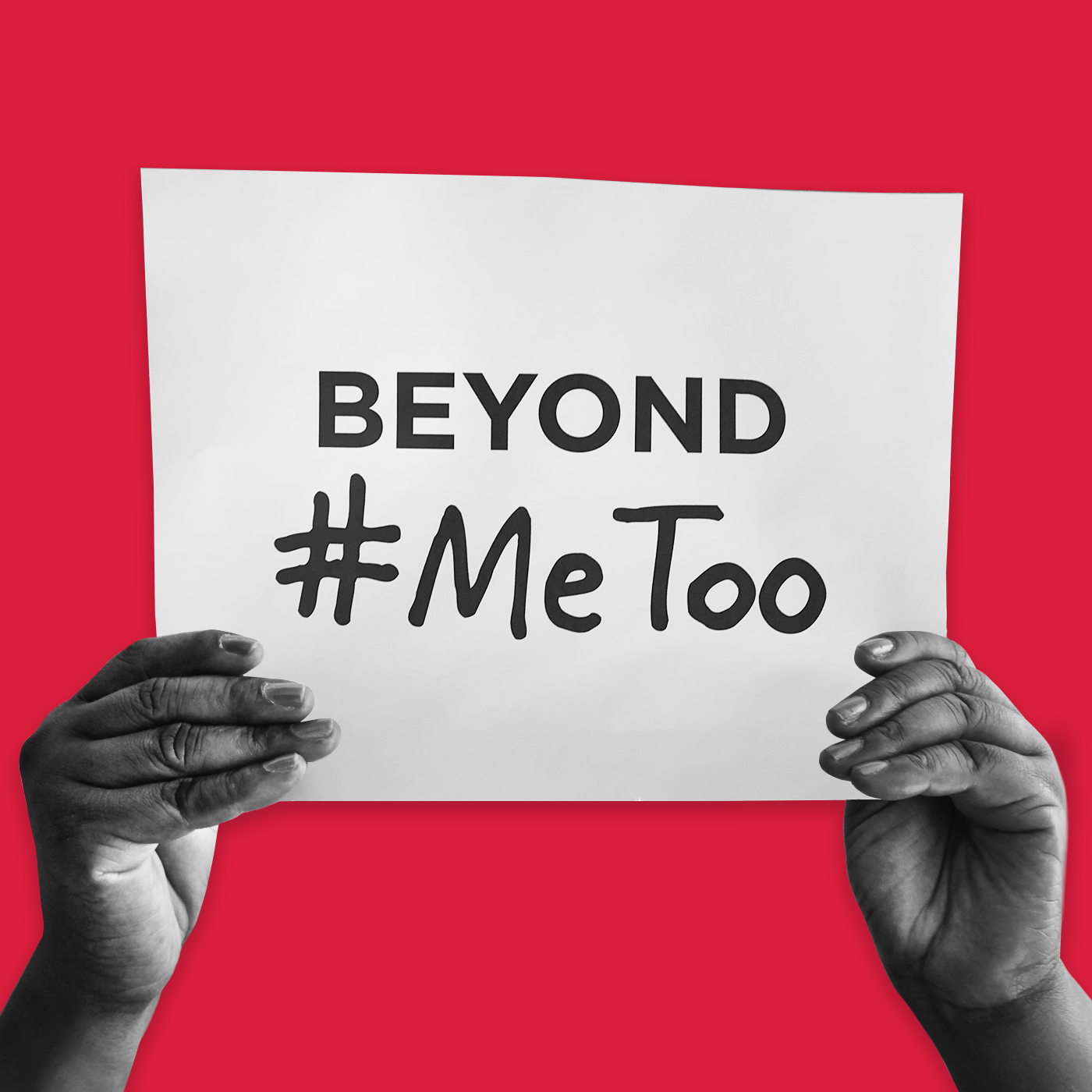
The #MeToo movement, and the wave of awareness which followed about domestic violence, workplace harassment, and gender-based violence more generally, was long overdue.
But it didn’t stop the election of Donald Trump. It hasn’t resulted in root and branch changes to how some of the world’s most powerful nations staff their top tier of power holders. It hasn’t influenced the accepted norm, the world over, that men can use violence against women as a weapon.
In Vietnam, as this week’s commemorative anniversary of the end of a brutal and protracted war draws to a close, the government continues to flagrantly lead from the front in terms of the male-female ratios of its leaders. And they are not alone in doing that. It’s the same everywhere.
Everyday, unchallenged, predictable and disastrous decisions are made by men.
Yesterday, in an interview with Peter Tufano from Saïd Business SchoolPaul Polman concluded that covid-19 had “shown the gaps that exist in our society”, and that a “global crisis like this requires a global response”.
Polman, who stood down from running Unilever at the end of 2018, is a seasoned businessman when it comes to discussing sustainability issues. Under his leadership, Unilever helped lead the charge, on behalf of large corporations, in defining why pursuing a “shared value” agenda (coined as such by Porter and Kramer in the Harvard Business Reviewalmost a decade ago) might end up being more than just a newfangled public relations exercise.
From designing a unique global sustainability charter (The Unilever Sustainable Living Plan) for their business operations, and investing in their own accountability frameworks and evaluation metrics for this, through to chairing the private sector group who influenced the UN’s shaping of the current Sustainable Development Goals, Unilever’s ten year sustainability trajectory under Polman paved the way for many other industries.
Way before this last particular decade, many of Unilever’s brands had more than dabbled in the “CSR” space. One of the first tie-ups I learnt about, when I joined CARE International in 2006, were the hand-washing initiatives led by Dove soap in south Asia, and which engaged local CARE teams in finding innovative ways to distribute health messages to rural communities.
It was clear to me, during my initial years with CARE in London, that Unilever had an omnipresent feel about it as a company, in terms of its presence on the sustainability scene.
When I joined the WSUP management team in 2008 for CARE, Unilever were one of the most active private sector partners, determined to prove that the answer to global water-sanitation issues lay in the collaboration between government, private sector and civil society working together.
And then, by 2010, CARE had launched JITA, a rural sales programme in Bangladesh that relied on everyday products being sold by local tradeswomen. No surprise, then, that Unilever had pioneered the earlier pilots to JITA, adapting certain products for harder to reach communities (also no surprise that it was Professor Linda Scott from Saïd Business School who championed a significant investment in measuring the impacts of JITA’s work).
Indeed, in the arena of the emerging partnerships and collaborations, which I saw take shape during those years, Unilever were front-runners.
Moving to Vietnam in 2011, I spent more time in the Asia-Pacific sustainability arena, only to find a similar dynamic out here, with Unilever once more driving the debates and popping up at conferences and seminars to lead the examples of good practice, particularly when it came to partnerships and sustainability.
So, in many ways, Polman’s insights yesterday fell well in line with what I would expect him to say about the current covid-19 pandemic.
Words are easy – real and sustained action tends not to be so.
The tension with putting words into action is not a new phenomenon. I’d be the first to challenge a lot of the work that companies put out there under a sustainability banner. To me, we’ve a long way to go on the topic of forging genuinely meaningful and long lasting partnerships between different organisations and especially when it comes to multi-national companies.
It seems to me, though, that covid-19 has somewhat re-written the script, not just for how businesses might engage in societal and environmental issues, but how every organisation engages.
Every conversation that anyone in the world is having today is in some way influenced by covid-19. It has changed everything. Forget starting any new chapter headings, we all need to learn a new language to read this particular book.
And that is, perhaps, why I found Polmans’ words so inspiring.
Already, covid-19 and the new realities it has brought upon society, simply must now be a catalyst for changing the way organisations work together. Somehow, before old habits and models and behaviours are allowed to creep back in, we must foster long-term commitments by government, private sector, and civil society to actually be the global “responders” that Polman is insisting are required.
In the interview, Polman cites some immediately comforting examples of where health, tech, pharmaceutical, and manufacturing sectors have collaborated together to address the pandemic. The world is rising to certain aspects of the challenge it faces.
Many commentators have been quick, also, to recognise the very positive way in which these recent months can help shape a healthier society in the future. One where larger numbers of people make choices not geared towards satisfying their own desires or needs.
Also in the mix, as the realities for the world’s poorest and most marginalised population groups come sharper into focus, is a greater awareness about the extent to which covid-19 will almost certainly end up further increasing the world’s inequalities – inequalities that have for so many years exacerbated the vulnerabilities of those living with very little prosperity and facing constant injustices.
As Polman mentioned yesterday, every year 8 million people die because of cigarettes, and 7-8 million because of air pollution. That the fatalities for which covid will be responsible won’t reach such numbers, further highlights perhaps the complacency that exists about the sales of tobacco and the number of regulatory controls that effect air quality.
I listened earlier in the week to someone on the radio talking about the many millions of people the world over who, for reasons of old age or disability, have been self-isolated from society their whole lives. That radical re-thinking about the digital and virtual nature of providing services and products – be they educational or health related, or other – is now well underway because of covid-19 is both exciting and deeply revealing.
Does this mean covid-19 embodies some type of perfect humanitarian storm of circumstances, out of which new alliances, partnerships and cross-sector collaborations will be forged? Did the world need the “re-boot” that I’ve read some people describe the current circumstances as?
Time will tell.
To quote Polman from the start, this crisis like none other before it, is “showing our society’s gaps” – for everyone to see. Acknowledging these gaps is one thing. Finding the right, long term solutions to them is another.
Polman indefatigably believes that the right type of solutions will only be found if the world works together.
And, at this point in time, I can only whole-heartedly agree.
This morning I woke up to a flurry of whatsapp messages from my cousins in the UK.
The messages drew from our respective memories of making child-hood visits to our grandparent’s house, down in Ramsgate, Kent.
What felt, for my brother and me back then in the early to mid 1980’s, like a life-time spent in the back seat of our parent’s car (playing ‘I-spy’, stopping at service stations, before – at last – pitching up alongside the seafront, and knocking on the pale green back-door, awaiting our Grandad’s inevitable greeting of “not today, thank-you”) was brought back to life in the moments of recall described in my cousins’ whatsapp chatter.
The instant recall and sentiments that popped up in these messages was palpable. Our Nan’s signature offerings (cherry cakes, iced fingers, Dandelion and Burdoock fizzy drinks, apple and blackberry pies) alongside our grandparent’s familiar household ornaments (a glass-topped table displaying our school photos, KP salted peanuts in a bowl, and a walnut cracker proudly stood between a family of wooden elephants) and then the excitable excursions we all took in between being served up huge quantities of food (down to the games arcade, “moving the flags on the putting green” and throwing little parachuted plastic soldiers off the white cliff tops).
The picture painted was so very satisfying and instant. I sensed we’d all happily opened our hearts to it, and to being back there again.
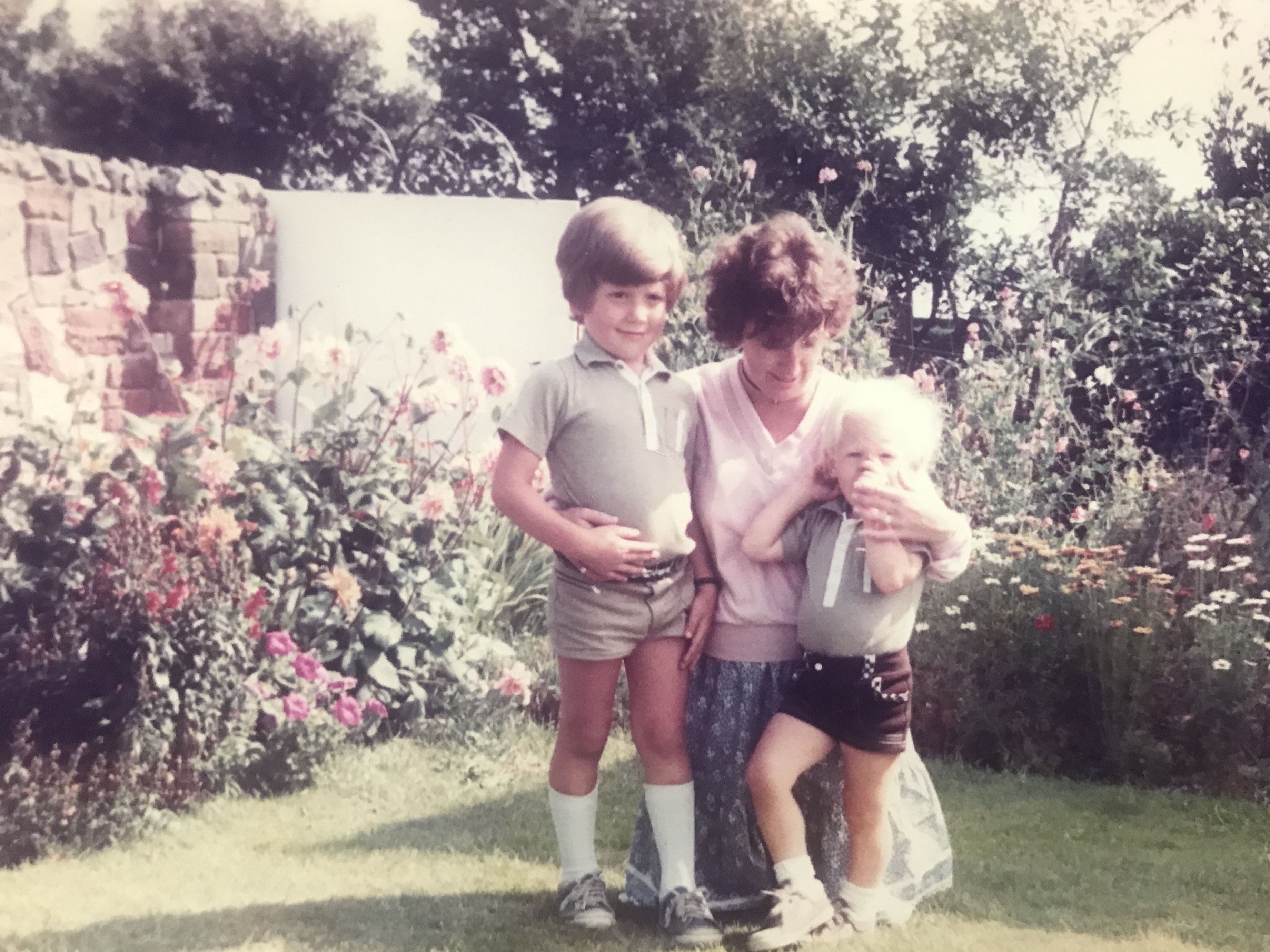
Me, Mum and my brother, Matt, in our Grandparents’ garden in Ramsgate, circa 1980.
Amid so much turmoil right now, these moments are sacred and unifying.
When markets recover and normality is restored, regardless of how shaped it will be from these recent times, there is a sense (shared by some commentators) that our ambitions and values, and sense of civic responsibilities, might have been enhanced in a positive way. That we will, perhaps, think more about each other, and less about our own desires.
Part of the anxieties surrounding these present and future scenarios could well be the ‘not knowing’. The lack of control we have in the current moment. The diminishing returns being presented to those of us unaccustomed to such a reality.
Already, in the international development sector (the core realm from where my definitelymaybe posts typically begin their journey) much is being written about the fact that, for years now, we’ve designed development programmes for marginalised communities around the world that ultimately try to build people’s capacities to be resilient in the face of crisis. How to best absorb, adapt and transform when “shocks” occur.
The related concepts and tools published about resiliency are multiple.
The learning cycles that unfold in typical social development programming have never been easy to fully articulate, nor, ironically, to learn from. I imagine, in current times, powerful lessons will be captured about resiliency, from countries around the world who are themselves locking down right now, freezing their economic development, and moving into unprecedented waters.
The reasons that programme learning cycles might not be up to scratch are many. There can, for example, often be no clear learning strategy made early on in the design of a programme, which then undermines learning at a later date. There are awkward funding processes, too, which mean organisations aren’t always readily resourced to invest in their partnerships, and in their learning, because they are under pressure to chase down the next grant.
I think there also exist fundamental divides between the different stakeholders engaged in social programming. Namely, and crudely, those designing and implementing and then those on the “receiving end”. Whilst there are a plethora of human-centred design frameworks growing in number (where the emphasis on design is led by “end-user”) too often organisations are not localising their solutions.
We devise a micro-loan product, for example, without properly testing the assumption that micro-loans are needed or desired. A training course might provide women with new skills and the confidence to earn better income, without involving their husbands in the process, and considering the consequences of the dis-empowerment which this new dynamic might cause the men.
Right now, one of the outcomes of Covid-19 is that some people are turning more attention “inwards”, to their families and friends – looking for answers, for reassurances, for distraction, for compassion and empathy, for something light-hearted, something human.
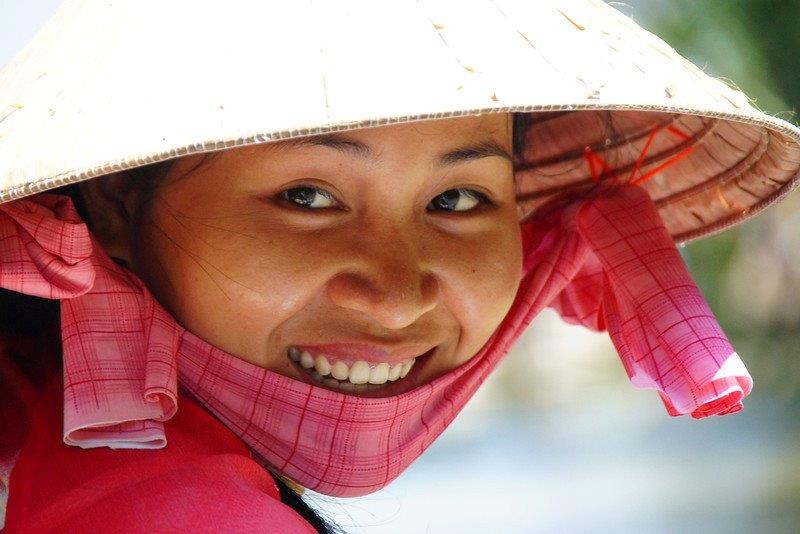
These acts of unity and solidarity are, in many ways, the same acts playing out everyday, and across every local community, acts born out of survival and respect, given freely and with humility. From the street-vendors I pass here in Saigon, to the farmers harvesting rice in the fields outside the city, and the young woman working in a garment factory and sending home her earnings.
There is a unifying chemistry binding people here in Vietnam who are, one day at a time, hustling to make a living, coping, ready for things to change one way or the other, determined to keep moving forward.
Theirs is as wide spanning a connection, in a country of 96 million, as can be made. A rich network of knowledge and intuition, of grit and resilience.
Have we, perhaps, missed the simplicity of answering some of the world’s weightiest development challenges by trying to invent solutions too complicated, with processes and systems too politically charged, when the actual answers are staring us in the face?
What does sustainable development look like beyond the horizon of this current pandemic, and in light of what can be learnt from it, I wonder?
That is to be seen.
However, it feels our biggest chance to learn from one another – on so many levels – and to put that learning into practice in the future, could come from these inward facing instincts and, indeed, in this very moment of our time.
My Grandparents, Ron and Lilian, with my Mum and her brother, Brian. Early 1970s.
My apologies upfront if you arrived at this post under the impression it would offer up relationship advice. Instead, I’m here to discuss the increasingly common pursuit of Cross-Sector (in particular, business and non-profit) Partnerships, and where they often run into trouble.
In many ways, looking closer at what makes for a successful individual relationship (be it with your manager, your partner or anyone else for that matter) is no bad place to start when it comes to establishing what it takes to maintain decent Cross-Sector Partnerships.
As explored in last month’s post there are some fairly stock conditions and behaviours that characterise good partnering – suitable preparation, clear communications, mutually beneficial goals, openness, honesty and regular evaluation, being just a handful of examples.
Let’s assume, then, that doing the opposite to any of these conditions is immediately going to put your partnership into more perilous scenarios. None of these conditions on their own are necessarily deal-breakers or deal-makers. But, combined, they will provide a robust framework from which to explore and experiment.
So, given an understanding of the types of conditions which are optimal for partnering, what might be some of the more subtle tell-tale signs that your partnership is, in fact, headed for the rocks? Here are some to contemplate:
#1 Early onset Complacency Syndrome.
Each partnership between a business and a non-profit (let’s stick with these two types of organisation, although the rules are relevant for other sector combinations) has it’s own unique context. If we assume that both organisations have done their research upfront, are partnering towards a shared goal, and have made initial investments of resources into the partnership, it doesn’t then always follow that the rest of their partnering experience will unfold as planned.
A symptom to look out for, that can often be traced right back to the early stages, is that of complacency. In my experience, particularly where funding is involved, complacency can occur on both sides.
On the side of the business partner (typically funding the non-profit in some way) there can be an instinctive sense of entitlement. This is, perhaps, unavoidable but still worthy of note. Many relationships that a business manages include those where that business is paying for something. Albeit with an agency or with a supplier, a business and its employees can have a subconscious expectation that they are in the driving seat because it is their money enabling things to happen. If they want a meeting at short notice, or they cancel a meeting at short notice, that isn’t to be taken as disrespectful, because they are the funding entity, so they are allowed to call the shots.
On the side of the non-profit, the side most likely receiving funds, another form of complacency can emerge. Again, this isn’t always the case, but I’ve seen non-profits, who are under pressure for funds, sign “partnership” agreements with corporate donors and, once the ink is dry on the contract, the non-profit moves onto the next funding target.
The over-arching point here comes down to discipline. Whatsoever your reasons for engaging with another entity – in a relationship that you are labeling a “partnership” – it is not good enough, nor sustainable, to take anything for granted. If the fit between two organisations is honest and meaningful then, as with any of the relationships in your life to which you place value, the act of being a complacent partner will hopefully not materialise, nor be accepted.
#2 – Nurturing your Partner’s “Value-Add”.
Let me caveat that “Value-Add” is jargon. An overly-hyped phrase, it flies off the tongue at most Partnership Conferences or workshops these days. However, beneath the jargon lies a revealing symptom.
Companies who partner with non-profits, or with public sector organisations, are increasingly being asked to demonstrate their Value-Add, when it comes to helping address societal issues. A social development organisation seeking to partner with a business is under pressure to do the same. Indeed, worthy Cross-Sector Partners will identify what their Partnership brings, as a combined team. Those in the partnership will articulate what is often referred to as a “Value Proposition” even, and spend weeks and months refining this together.
When done well, taking a systematic approach to Value Addition – in our example, this translates as two organisations clearly spelling out what it is they want to achieve together, how they will be successful, and why their partnership stands out from others – can reap dividends for all involved, and deliver great outcomes for the partnership.
Are your Partnerships built for learning or do they rely on jargon and platitudes?
However, I’ve seen lip service approaches taken by organisations when it comes to recognising each other’s contributions and, as a result, not then taking steps towards helping evolve and nurture these contributions.
Organisations, particularly large ones, tend to be internally focused, strapped for time, complicated to navigate, and highly political. For those managing partnerships, there is simply not always the requisite amount of bandwidth, in one’s typical day, to spend that critical time learning more about the organisations with whom you are partnering.
This, it seems to me, is a missed opportunity. How might an organisation ever truly partner with another if that learning component is never fulfilled?
To be clear, partnering with another organisation doesn’t mean you can’t disagree with something they are doing (or have done) and it definitely shouldn’t mean you can’t call out bad practice. On the contrary, some of the companies partnering NGOs are seeking that very regular and wholesome critique from the NGOs they partner. Certain companies even evaluate their partnerships based on an NGO’s ability to do just that.
And, yet, the majority of organisations aren’t prepared to invest the time and resources to learn from each other, and learn about each other’s industry.
Which has never made sense to me, given the most rational case for establishing a Cross-Sector Partnership in the first place should be the realisation that your organisation’s goals cannot be achieved unless you work with other entities (and particularly those who bring skills and knowledge to the table that you don’t have).
Without fulfilling a commitment to explore what your differences are, and how you can compliment each other (and, over time, make each other a more rounded and robust outfit) organisations run the risk of simply partnering for partnerships’s sake.
#3 – Owning your Mistakes.
In the realm of Cross-Sector Partnerships there is a narrative shaped around what that partnership is doing (or intends to do) which often relies on a heavy dose of positive public relations. CEOs will pepper a conference speech with crowd pleasing intentions. New brand campaigns are created in the process. Press releases fly about social media. A hashtag is born. And so things escalate.
Behind the scenes, however, Cross-Sector Partnerships are reliant on individual relationships between multiple people. What can happen in the furor of a new Partnership is that individuals become carried away with the compelling narrative, and impermeable to doing wrong. And one thing we know about human relationships is that it’s doesn’t always come naturally to people to accept responsibility for things when they go wrong. This is particularly evident inside the workings of an externally published partnership, high off of its own sense of self-worthiness, and all that it has set out to accomplish.
When things go wrong in a partnership, all too often one side will blame the other (either directly or covertly). It can then be a cumbersome, and ultimately fatal, process continuing the partnership in the wake of an episode where individuals have thrown each other under the proverbial bus.
Much can be done to prevent this from happening (again, the importance of giving due consideration upfront about the nature of a partnership, or then advocating clear ways of working as the partnership progresses, are two such examples). Although the true test lies in people’s commitment to learning and to improving both their own practices and behaviours, as well as that of their respective organisations.
Doing so requires courage, some risk taking and a sharp sense of what it means to do the right thing.
I am sure many examples can be thrown back in my face of situations where organisations did the very opposite of the right thing, burying bad news stories or unethical practice, and lived to tell the tale.
Equally, I have my anecdotes of where my own handling of a sticky situation with a partner organisation was conducted in a way that protected my team from receiving just blame. Regretfully, there are probably more than one of these to recount.
And yet, I am convinced of the fact that Cross-Sector Partnering would be more impactful, with more sustained and productive outcomes, were we to work harder at trusting each other, and owning our mistakes and the times where we might have misjudged a situation. Easier, of course, to say than to live out, but we must try.
So, there you have it.
My three Tell-Tale signs to look out for when embarking on serious Cross-Sector Partnerships, and which apply to you and your partner organisation:
Relationship Complacency;
Not investing in each other’s Value Addition; and
The inability to accept that Everyone Makes Mistakes, from which we can all learn.









 definitelymaybe