Viability vs. Visibility: The Tragedy of Modern Leadership

https://www.newsweek.com/white-house-elon-musk-doge-sec-target-conflict-2032567

Just been reading that Elon Musk is stepping down from his role at DOGE, the government department set up to save the US economy from wasted spending.

I’ve briefly shared my view on DOGE and on Trump, and I mentally flit between one day wanting to write more about how both entities are impacting the world (negatively, in my opinion) and the next day simply wanting the whole circus that is the US Republican administration to fall off the face of the earth.

If only there were some decent Democrat spokes-people out there, these past five months, to counteract the daily ordeal each of us faces when we read the news. Lucky enough I found this guy, Harry, to be a helpful and passionate critique of Musk and Trump.

There’s very little in this piece he posted recently with which I disagree.

The one thing I’d add to this latest piece “news” about Musk leaving DOGE is that, aside from the long list of grievances one would be well justified to level at Elon Musk (Harry covers this neatly, so I don’t need to), and aside from his general awkwardness with everyone he meets, and how he communicates, the thing that sticks most in my throat is his inability to collaborate.

His purchase of Twitter/X has only made his individualism and ego even more pronounced.

Forget the viability of something anymore (be it, say, the “truth” or simply the credentials of one’s EV business) many social media sites have together reframed what is important for society and that, it seems to me, is not viability, but visibility.

Misinformation thrives in these online spaces. Very complex ideas and hypotheses are flattened out into bulleted “top tips”. Twitter, in many ways, is a platform which has gamified shortened attention spans and praises individual’s visibility and their brand.

Which, of course, offers the perfect ground for performers like Trump and Musk, who pretend to be leaders, but act more like ham-fisted Copperfield illusionists. All accountability is removed. All sense evaporates as soon as they start speaking. They don’t answer questions, they gaslight, they lie, they rinse, they repeat.

While Musk claims to build for the future, with neural interfaces and colonies on Mars, he is a caricature of all the shitty habits and traits that we’re collectively adopting from spending too much time, ironically, scrolling through Twitter feeds.

It’s well documented that many people find it ever harder to hold their attention on simple tasks and activities. Young professionals, in particular, embrace more performative ambitions about what they want to do as individuals. It feels, a lot of the time, like there is a fading appetite for collective progress, as folks rush about in a melee of self-made busyness and unfinished projects.

As Musk bounces from city to city, flexing his enormous bank account in front of politicians one day and Silicon Valley the next, we watch as climate plans get drafted annually at COP Conferences, before being routinely shelved. We observe social justice campaigns that trend for days, before being eclipsed by celebrity gossip or some other geopolitical outrage.

Musk is a symbol for these contradictions. His own portfolio reflects a restlessness where the next ambition supersedes the existing one. Bored of this project now, move on.

Perhaps all of this is inevitable, given the world’s richest man is able to sway the markets with a single tweet, and can basically say or do what he wants today, and then pay for the damage afterwards, knowing that tomorrow we’ll all have moved on to the next click-bait article.

Nice heels, cowboy.

Musk is not alone, of course. As Jeff Bezos floated into Cannes earlier this month, in his $500m schooner, the irony was not lost on those who’ve followed his outspoken support to address climate change. And let’s not forget his Blue Origin space flight debacle. No, let’s.

Whichever of these wealthy elite you handpick for analysis, you’ll find the same paradoxes. The allure of the solo operator, at this echelon of society, remains powerful, there’s no doubt about that, and especially in a world that feels increasingly ungovernable. But the actions and behaviors of these individuals, forging ahead, indifferent to consensus, and chucking U-turns on a weekly basis, smacks of ending up brazenly erasing the work of thousands of others.

And, this approach fundamentally ignores the necessity of institutions, of partnerships, and the wholesome bindings of community. All of which are needed if we’re to arrive at long term solutions to global problems. We don’t need Musk or Bezos to do that.

You can tell me that Musk is responsible for cutting edge technological breakthroughs but, even if I choose to believe that, the nature in which he is conducting himself does not sit well with me, nor fill me with anything other than fear.

Musk, Bezos, Trump: these characters are in the headlines all the time, and they dominate how we think about change because of that. That’s a red flag.

Change that the world urgently requires is slow and deeply collective. We need sustained cooperation, and instead we run the risk of remaining stuck in a loop of promising beginnings and spectacular distractions.

Turn Debt into Hope

https://walletgenius.com/loans/why-debt-relief-plans-might-be-better-than-debt-consolidation/

Do you remember much about what you were doing twenty five years ago? Maybe you can recall how you spent that final New Year’s Eve of the 20th century?

Fun fact, that specific NYE, with only an hour left until midnight, I found myself responsible for introducing an old school friend to the woman who turned out to become the love of his life.

Anyway, while some of us were downing drinks and match-making at a bar in South West London, others were galvanizing global attention about world debt, and its impacts on least developed nations. The Jubilee 2000 movement led that charge at the time, their efforts leading to the cancellation of over $130 billion in debt for 36 countries.

A monumental effort which enabled nations to redirect funds toward critical sectors like health and education, offering millions a pathway out of poverty. But, fast forward to 2025, and the call for debt justice still resonates, only things have got worse.

I’ve been working recently with Caritas International, and have come to know about the launch of their “Turn Debt into Hope” campaign, urging the cancellation of unjust and unsustainable debts that, to quote from their website, “hinder nations from investing in their futures.”

From some quick research it seems that, back in 2000, the total external debt for the world’s Least Developed Countries (LDCs) was approximately $150.4 billion. External debt today, for the 31 poorest, high-risk countries, has now topped $200 billion. We’re seeing the highest burden of debt in 30 years.

​This increase means that even more substantial chunks of money from the world’s poorest governments are being diverted away from public sector needs and, instead, allocated to repaying these debts.

When you then consider other ‘crises’ that encroach upon a country’s economy – be it the slow onset ramifications of conflict, or the rapid emergency of an earthquake (much like the one Myanmar experienced a week ago) – it becomes impossible to see how these debts will ever be repaid.

In the aftermath of a crisis, economies dive, job losses occur, inflation prices scupper spending, and a whole myriad of other economic outcomes conspire to spiral a country out of all control.

Waking up this morning to the news of Donald Trump’s sweeping tariffs (which includes a 10% baseline on all imports, and higher rates on key trading partners such as China (34%), the EU (20%) and a whopping 46% here in Vietnam) it is obvious these escalating trade tensions will only lead to market volatility, to fears of a global economic slowdown, and the inevitably unequal impacts of that on so many of the world’s developing countries.

It’s a brutal, cruel economic conundrum, because it is the most vulnerable communities who face the highest threats.

As I’ve been prone to highlight here many times before now, I believe the role of the private sector to be key in these debates. And yet, too often, these conversations happen without the private sector in the room.

That needs to change. Companies are increasingly recognizing that their long-term success is intertwined with the well-being of the communities in which they operate. Engaging with initiatives that promote economic justice, such as “Turn Debt into Hope”, aligns with corporate commitments to Diversity, Equity, and Inclusion (DEI).

By advocating for, and participating in, debt cancellation measures, businesses can play a role in contributing to the creation of more stable and equitable global markets. All of which, ultimately, benefits everyone.

Twenty five years ago, the Millennium Development Goals (MDGs) set out a charter, with a fifteen year timeframe. The MDGs sewed into their narrative this inference about partnership and the role of the private sector, however it’s been a slow process to bring business to the table.

Genuine collaboration takes time, and today we need to keep banging this same drum, hoist up this same flag, and loudly promote why multi-stakeholder collaboration, that includes business, can be instrumental in addressing both immediate financial injustices, while also laying the groundwork for sustainable development.​

The principles that the 2000 Jubilee Campaign champion are more pertinent than ever. We’re experiencing an era marked by economic uncertainty, by geopolitical tensions, and by ongoing climate crises. Debt cancellation is a crucial lever for promoting stability and prosperity, and we cannot wait another quarter of a decade for action in this space.

The children of my old school friend, who met his future wife on New Year’s Eve in 2000, are already in their twenties. Theirs is the generation now grappling with the implications of a world that procrastinated over its responsibilities.

Do please consider donating to any of the organisations currently providing humanitarian assistance to communities in Myanmar affected by the earthquake – here is one.

Private Sector Engagement in Southeast Asia: The Moment for Bold Action

For fourteen years, as long as I’ve lived in Saigon, I’ve been blogging about ‘Private Sector Engagement’ – its evolution, its setbacks, and its vast potential to drive social and economic change. Time and again, I’ve emphasized one thing: alliances with business are not just beneficial, they are essential.

Yet, at a time when global companies are facing political pressure to roll back Diversity, Equity, and Inclusion (DEI) programs, there’s a real risk that corporate commitments to broader social impact (including sustainability, worker rights, and responsible business practices) could be deprioritized or abandoned altogether.

With government funding for aid shrinking fast, the question is no longer whether the private sector should play a role in sustainable development – but how fast we can make that happen? Companies must resist the temptation to step away from ESG (Environmental, Social and Governance) commitments, or drop impact-driven business models. Instead, they must double down on sustainable, long-term strategies that create both profit and positive change.

Rather than dwelling on the alarming consequences of these funding cuts (which many commentators are documenting well), I want to underscore why this moment demands a shift.

From my work in sustainability consulting, business partnerships, and initiatives with CARE, I’ve identified the following key trends shaping this transformation.

The Rise of Impact-Driven Partnerships

Corporate Social Responsibility (CSR) in Southeast Asia has long been philanthropy-driven, with companies donating to social causes without embedding impact into their core business. That’s shifting.

While there’s still a place for sponsorships, more businesses now see the value in long-term, strategic partnerships with NGOs and social enterprises. CARE has always been my “go-to” on this, for examples of the innovations used to secure “win-win” partnerships with corporations – I’ve listed their collaborations over the years with the likes of Barclays, Allianz and GSK as just a few examples.

In Southeast Asia, many other organisations have worked collaboratively with companies. World Vision & Procter & Gamble in the Philippines, for example, ran a Hope in Garbage project, which collected 3.2 million plastic sachets and 870,000 plastic bottles, upcycling them into 1,040 chairs for schools – a great model for sustainability and education impact.

Here in Vietnam, The East Meets West Foundation, also known as ‘Thrive Networks’, partnered with GE Healthcare to enhance healthcare infrastructure leading to the development of medical institutions, and the provision of custom-designed equipment to hospitals, aimed at improving neonatal care and reducing infant mortality rates. ​

Even in industries like apparel, where brands once relied on short-term worker welfare programs, we now see the co-development of ethical supply chains with sustainability organizations. CARE and the ILO’s early 2000s work laid a lot of the foundations for this, and entities now, such as RISE, are pushing ethical supply chain development even further as result.

Where to from here? To me, the answer is clear. Organizations – NGOs, especially – engaging with the private sector need to move beyond sponsorship requests and, instead, position themselves as strategic partners that bring business value, through such things as innovation, market access, or risk mitigation.

The Shift from Compliance to ESG-Driven Business Models

ESG factors are becoming a competitive advantage, rather than a regulatory burden. Investors, consumers, and governments are increasingly pressuring businesses to embed sustainability into their operations. The result of which is that large corporations are developing ESG frameworks, not just to comply with regulations, but to attract investors and gain consumer trust.

And with this trend, we are seeing multinationals now pushing sustainability requirements down their supply chains, impacting SMEs and local businesses.

Governments in our region are also starting to integrate ESG into investment policies and corporate reporting frameworks. Both Vietnam and Indonesia, for example, highlight ESG in financial reporting, investment strategies, and regulatory frameworks.

Vietnam even has a “report or explain” framework and Corporate Governance Code which both promote transparency, while Indonesia’s OJK Regulation No. 51/2017 mandates ESG disclosure for listed companies.

As ESG gains traction, the non-profit world can play a more prominent role in ensuring businesses go beyond compliance to create real social and environmental impact. NGOs can add value by training smaller companies on ESG compliance, reporting, and sustainable business models, and also facilitating partnerships that ensure corporate ESG aligns with local needs. There is also room for NGOs to play a role in accountability, monitoring ESG commitments, preventing greenwashing, and pushing for stronger corporate governance.

The Growth of Market-Based Solutions & Inclusive Business Models

Lastly, one of the most exciting trends I think Southeast Asia is experiencing, is the rise of businesses integrating social impact into their core revenue models. Rather than treating sustainability as a cost center, companies are developing commercially viable solutions that also drive impact.

As such “circular economy” models are emerging, particularly in sectors like textiles, packaging, and agriculture. Whilst social enterprises are scaling through corporate partnerships, blending business growth with community impact.

I saw this firsthand as early as 2007, when I worked on CARE’s rural sales initiative in Bangladesh – a project that later spun off as JITA, itself a stand-alone social enterprise in 2012. Since then, the region has only expanded its approach, with more companies exploring inclusive business models that drive both profit and impact.

These ventures, requiring businesses to engage with underserved communities, need cross-sector expertise, opening up opportunities for collaboration between the private sector, NGOs, and impact investors. Organizations that can align their business goals with market-based impact solutions will, in my opinion, have a stronger case for funding and growth partnerships.

Where to Next?

Private sector engagement in Southeast Asia is no longer an option in my view – it’s a necessity. With aid funding brutally slashed, ESG becoming mainstream, and political pressure mounting against corporate social commitments, businesses and impact organizations must collaborate in smarter, more strategic ways.

In the face of backlash against DEI, we must recognize that ESG, sustainability, and inclusive business aren’t just about good optics – they are about long-term business resilience, risk management, and innovation.

Businesses should move beyond compliance and integrate ESG and impact into their core strategy, rather than retreating from it. Whilst NGOs must stop just chasing sponsorships and become strategic partners that offer value.

The opportunity is there for the taking. The question is: who’s ready to lead, and who will fall behind?

What next after CSR?

Subscribe to continue reading

Subscribe to get access to the rest of this post and other subscriber-only content.

Stuck in our ways

Gaza, 2017. Photo credit: Tim Bishop

I read two things last week, coincidentally connected.

The first was a report from CARE International, offering insights about the impact COVID-19 has had on the local community groups that CARE has been seeking to support for decades.

I commend this report to anyone with an interest in the topic of international development. The analysis is rigorous, yet the recommendations are simple. The tone is calm, but unsettling, given the evidence being shared, which points not to the successes of the international development community, but instead underscores its failures.

It cites how impactful the pandemic has been, in terms of increasing, rather than decreasing, gender inequalities.

It also proposes that far too much potential progress in development is “held back by the deeply colonial approaches” still adopted by global development organisations, including CARE themselves.

Sifting through social media feeds, I then stumbled upon this quote from the novelist and cultural critic, James Baldwin:

“The entire purpose of society is to create a bulwark against the inner and the outer chaos, in order to make life bearable and to keep the human race alive. And it is absolutely inevitable that when a tradition has been evolved, whatever the tradition is, the people, in general, will suppose it to have existed from before the beginning of time and will be most unwilling and indeed unable to conceive of any changes in it. They do not know how they will live without those traditions that have given them their identity. Their reaction, when it is suggested that they can or that they must, is panic… And a higher level of consciousness among the people is the only hope we have, now or in the future, of minimizing human damage.”

Drawing these two “things” together (CARE’s report and Baldwin’s musings) doesn’t take a considerable amount of effort: the traditions to which Baldwin refers, are part of the very reason that international development has failed. The traditions that dictate the colonial influences over how aid has been invested, coupled with the traditions which set the social and cultural constructs that exist on the side of the recipients of that aid, create a perfect storm of incompatibility.

For sure, there are examples of success, and I have spent time on these pages promoting them.

Unfortunately, these are overshadowed by examples of failure, and worse: examples of repeatedly making the same mistakes over and again.

Signing of The Marshall Plan: from http://www.sucesoshistoricos.com

In 1948, the United States committed to the rehabilitation of Western Europe, kicking off the “Marshall Plan” as an investment to help countries after the War.

Many of the recipient countries of the Marshall Plan – Britain, France, Netherlands, Belgium, West Germany and Norway – had, themselves, previous experience of providing aid to countries years before.

Foreign assistance, as a concept, had been around since the 18th century. However, since that time, the majority of the assistance given was from countries such as Britain and France, and predominantly to their respective colonies.

To recap, hastily, on how development has evolved since 1948, organisations (such as CARE International) have invested significant time and energy trying to understand how to most appropriately and effectively assist those “living in poverty”.

Those last three words are in speech marks, because defining who beneficiaries actually are has, itself, been a 75-year exercise.

The World Bank annually grade country demographics and, historically, many aid organisations and government donors use this guidance to allocate funds. Which is why more recently South American countries and now South East Asian ones, are receiving less “aid” due to how they have slowly climbed the World Bank rankings, moving from “low income” to “medium income” economies.

Using economic indicators such as these, some development agencies have prioritised the “extreme poor” as a target group for receiving aid.

Whilst others have nuanced their criteria for “poverty” and zoomed in on defining groups of people based on how “vulnerable” or “marginalised” they might be, which then takes into account criteria beyond income.

Over time, and as the international development industry has expanded, more types of people in need are included, in some way, by some organisation, or movement.

In any case, whilst they have been undertaking their deep dive analyses, and designing their ever-complex programmes, these organisations have encountered a slew of cultural and social normative behaviours (again, Baldwin’s ‘traditions’ – to which each community they are assisting is bound and, from which each community is so heavily defined.

For CARE, the gendered aspects of such cultural traditions – whereby men typically dominate decision making and hold the majority of power over women (at home, in the workplace, and in public spaces) – has become the lynchpin around which all of CARE’s efforts have been inspired.

For others, UNICEF or Plan International, for example, their research and development has anchored itself to the challenges that children or young people, respectively, face in society.

As many commentators have cited, the evolution of “aid” over the last 200 years has charted a meandering course, undergoing regular modifications.

Take the topic of financing, for example.

Many nations, and large development organisations, have explored what might be the most efficient financial instruments they can deploy: Government-to-Government loans; microfinance programmes; economic stimulus packages; public-private funded initiatives, designed to strengthen economies and improve societal issues.

Each of these examples, come with their own success stories however, without exception, each encountered this same obstacle of tradition on both sides of the equation: the traditional norms set by those investing funds and resources into development, and the traditional norms played out by those receiving the financial “help”.

Given these constraints, it is simply not clear, even today, what types of interventions are best and how these should be delivered.

Is it more appropriate, for example, to stimulate economic growth for a country or, instead, better to understand upfront what is needed by those in that country who are struggling financially and who are excluded from formal systems (ie they lack access to bank accounts, internet, markets, education, etc) and to design an intervention that addresses that need?

Both of these approaches have been tried and tested and, in some cases, combined. However, again, traditional norms create obstacles along the way.

For example, direct budgetary support (a financial transaction between Governments) was, for a while, a popular choice of many richer nations to financially support poorer ones. Yet, this type of support could be all too often undermined by recipient Governments not properly distributing the funds through public services. Instead, many would funnel disproportionate amounts into other areas, such as to the bank accounts of Government officials.

And, when it comes to implementing the second approach (ie answering the “needs” question) this, too, can be compromised by the nature of who makes decisions in society, writ large.

Not exclusively, but typically, all such development-based transactions, and development-based relationships in the past were led by men.

The result of which is that less consideration, over seven decades of international development, has categorically been attributed to those societal issues that would have been selected by women. Women simply haven’t had the opportunity to have an equal voice in conversations about international development in that time. Not in the initial orchestration of The Marshall Plan, nor in the decisions with, and within, communities in terms of where and how the resources should be utilised.

It was CARE who established the first ever Village Savings and Loans Association (VSLA) in Niger in 1991, a mechanism for women to save and loan money with one another.

This, in turn, inspired the scale up of VSLA platforms around the world, adopted by other organisations too, encouraging women to have a voice inside of communities, and ultimately enabling women to speak out and influence local structures and systems.

VSLAs are one example of how this acutely gendered dynamic and imbalance is shifting. Unfortunately, the pace of change is slow.

Take the issue of unpaid care. This remains a pertinent topic even in the most “progressive” of societies. In the world of business, equal pay and worker benefits are also not yet level for all employees. For many nations, their politicians and leaders have been, and in many cases remain to be, male dominated. As of 2021, only 1 in 5 ministerial positions globally were held by women and, even today, just 17 countries have a woman Head of State, and 19 countries have a woman Head of Government.

These stark ratios are reflected, too, at the local level of the majority of countries – in the political and public spaces of local authorities and community leaders, in small to medium enterprises and local businesses. The patterns are similar, the outcomes the same.

And, whilst today’s inter-connected world has increasingly called out these gender imbalances, in a way that simply wasn’t viable even 20 years ago, Baldwin’s intuition when he writes “They do not know how they will live without those traditions that have given them their identity” rings true.

Just as traditional norms hold back gender equality, so too do they stifle advancements made around other forms of inequality.

More than ever, we have been made aware of the economic inequalities of the world – the “1%” phenomenon.

Every country maintains its own version of this and, globally, it would seem that the ratios of the ‘haves’ and the ‘have nots’ become ever more extreme with each annual set of data released.

According to last year’s World Inequality Report, “Global wealth inequalities are even more pronounced than income inequalities. The poorest half of the global population barely owns any wealth at all, possessing just 2% of the total. In contrast, the richest 10% of the global population own 76% of all wealth.”

Armed with such data, it is hard not to side with those campaigning for change. Be that from an accountability perspective, lobbying for more responsible policies and practices adopted by business and by government institutions. Or be it from a more ethical perspective, targeting individual behaviours.

Both make sense, yet both have their limitations when it comes to just how much ground individuals, corporations, or governments, are prepared to concede at their own expense.

***********************************************************

With power comes responsibility, and all too often that responsibility lies in the shadow of a tradition that is extremely hard to change.

Whether you set your sights on tackling inequality, poverty, vulnerability, marginalisation, gender equity, disability, child rights, or other such societal issues, I would argue that Baldwin’s plea for a “higher level of consciousness” remains, simultaneously, a sobering as well as a viable salvation, when redressing some sort of balance in the world.

Although I was tempted to end this post conceding that Baldwin’s call to action might never be fulfilled, instead I would suggest that the subject of ‘consciousness’ gains more traction with each generation.

What if we kept a higher level of consciousness close to heart, and nurtured that sense of what it can mean each day? What if we tried to imbue Baldwin’s words and sentiment into as many interactions, thoughts, exchanges and relationships that we could accommodate?

Do this, and perhaps there may yet come a time where our connectivity with one another sets in train a new sense of what tradition is, what it stands for, and what new outcomes it might reveal.

Chopping the UK aid budget

I wrote over 8 years ago in support of George Osborne and his measures to improve transparency over corporate tax, and at the time the UK Government’s continued commitment to spend 0.7% of its gross domestic income (GDI) on overseas aid and development.

Some of the details about how the UK Government has performed against its original pledge, back in 1970, to invest this 0.7% figure, can be found in this round-up piece from last month.

45 years on from that pledge, and Britain did finally join other countries, about 6 years ago now, in achieving the 0.7%.

Sadly, however, the merger of the UK Department for International Development with the Foreign Office, in June 2020, thwarted any momentum that Boris Johnson’s team may have inherited from the Osborne-Cameron era on the topic of overseas aid.

The writing was on the wall then, and the Covid-19 pandemic helped ensure the latest announcement, made as Britain hosts the G7 Summit this week, that the UK will be cutting aid by $4bn. The news sent the House of Commons into a frenzy yesterday, with Tory rebel MPs challenging the Government’s decision.

These latest proposals for cuts mean as much as 42% reductions for some countries and, ultimately, an overall drop down to 0.5% of the UK’s GDI. A decision which many organisations and commentators have pointed out will sever vital funding to countries around the world, such as Yemen and Syria, currently facing respectively inhumane levels of social disruption and economic uncertainty.

Whilst the Government sees the cuts as temporary, there remains a chance of reversing the decision over the coming days. Let’s wait and see. The UK held a strong seam of respect during the Labour administration of the early 2000s, of being innovators in aid and reframing ways of ensuring funds were well spent. It was also that administration which championed the 0.7% target. This respect will evaporate if these cuts go ahead.

And so why this constant going round in circles when it comes to overseas spending?

Those in the UK who voted to leave the EU in 2016, and the many who have switched from Labour to Conservative since, may well represent one reason why these cuts have been put forward. The Covid pandemic has wrought havoc for many, through sickness, job insecurities, and generally uprooting people’s previous priorities. The Government’s recent success at rolling out vaccinations has also piqued public support for Team Boris. He’s “getting the job done”, as he said he would.

Ironically, perhaps, some of these same Leave voters, whilst in theory jubilant now that their votes weren’t cast in vain, could easily be supporters of a reduction in overseas spending, given the unclear economic picture for Britain now that the country isn’t free to trade with its European neighbours.

The same argument would also work for a Remainer, pissed off at Brexit, but concerned at the consequences facing a new dawn of trading and travel agreements – usefully illustrated below by Statista.

24212.jpeg (1200×1800)

Whichever your chosen political preference, or your views on Brexit, isn’t the case for investing in the social and economic development of other countries around the world, with whom the UK shares business and cultural ties, not good enough a reason to stick to a 0.7% investment?

Last I checked, the UK is host to a multitude of ethnically diverse towns and cities, and home to generations of overseas diaspora, working and paying more taxes than your average multi-national corporation manages to cough up each year.

All sorts of pompous claims are made by the UK about its “global credentials”, most of which rely 100% on Britain’s multi-cultural make-up and diversity – because it certainly isn’t the case that these global credentials can draw any currency from harking back to a time when Great Britain colonised other nations.

Whether the UK has a right to make any of these sorts of claims, or not, the country simply has to find its humanitarian footing in the world.

As a G7 country alone, the wealth commanded by the UK is colossal, when compared to other nations. The decisions made about how the UK invests that wealth is critical in combating social and environmental issues which are stressing everyone, no matter where they are from.

To be in that category of prosperity, to carry that decision making power and influence, impacting not just the 70 million people in the UK, but hundreds of millions of others around the world, is a privilege that many other countries will never experience in the next fifty years.

And, still, with this fortunate positioning in the world, the UK Government is in massive debt and cutting costs wherever it can. It always seems to have been that way. Which means the UK cannot afford to loosen any grip it has on its connections with other countries, in whatever form – its economy and society relies on other nations for so much.

Countries like Bangladesh, one of the places to have benefitted in the past from UK aid, and which could now have that support diluted, supply UK fashion retailers with millions of items every week.

From all across the continent of Africa, where UK aid has historically been of vital importance, the UK imports a range of products – vegetables, fruits, nuts, metals, beverages, chemicals, crude oil, to name a few – and as an import market Africa is key for the UK motor industry, for medicines and electrical equipment.

To Pakistan, one of the UK’s largest recipients of aid, the UK also relies on exporting industrial and power generation machinery, telecoms equipment and pharmaceuticals to the tune of $1.5bn a year.

For these trade partnerships to thrive in the future, it is in the vested interests of the UK to see social and economic development thrive in partner countries. It’s a win-win. It has to be seen like this, or else we will forever be circling the drain in terms of this debate about overseas expenditure.

There was a time when Britain sought aid and support from the world: 1945, at the end of the Second World War, during a period when my old organisation, CARE International, was established, and “CARE packages” were sent to war-torn Europe.

That commitment, by the USA, laid a foundational brick for the CARE network, which has succeeded year-on-year since, in supporting the most vulnerable and marginalised around the world.

Now is not the time for the UK to be trimming the fat off the very same type of budgets which came to the rescue of the many millions of British families effected by conflict 75 years ago.

On the contrary, it is the time for the UK to aspire to actually being a global leader and decision maker, known for raising the bar of investment in the wellbeing of others, rather than lowering it.

Making change happen: Collaboration, and the power of Storytelling

Blog-Timor-Leste-580x386
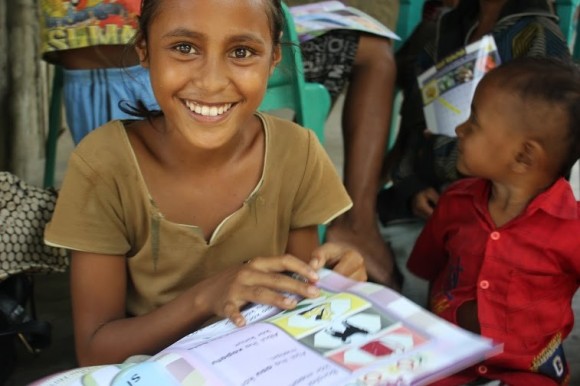
Children reading Lafaek Community Magazine. Photo Credit Sarah Rippin/CARE

I’ve been working in Dili, the capital of Timor-Leste (East Timor) this week, and it’s been a privilege as always to spend time in new surrounds. More so when stationed one hundred metres from the sea, with spectacular daily sunsets, and some of the tastiest coffee money can buy. 

Timor is an island, just a short hop north of Darwin, Australia, and up until quite recently, following 500 years of Portuguese occupation, was an Indonesian colony (between 1975 and 1999). The western side of the island is still governed by Indonesia. Timor-Leste claimed its independence in 2002.

Like so many other countries in 2016, Timor-Leste is experiencing the effects of the current El Nino droughts, disrupting the country’s wet season and ruining harvesting potential. A topic covered on this site back in March during my time in Ethiopia.

My assignment this week, however, has been to support CARE’s work to engage more with private sector companies in Timor-Leste (banks, retail, media and others) and examine ways in which, together, initiatives and relationships can be forged to tackle some of the social and economic challenges the country faces – poor infrastructure, lack of employment opportunities, issues around food security and nutrition, financial literacy, to name a few. Even without a more severe El Nino year, Timor-Leste is dealing with all of these mini crises combined.     Continue reading “Making change happen: Collaboration, and the power of Storytelling”

Raising the bar on tax

fundraising_power_of_one
What can you do today that will make a difference?

George Osborne, the UK Chancellor, was front page news yesterday, receiving positive plaudits from Action Aid and the ONE Campaign, as well as from other organisations also not known for being routinely generous with such public praise.

The story in question centres around how large corporations have skillfully dodged paying taxes to poorer countries in which they conduct business.  Osborne used his attendance at a G20 meeting of finance ministers to make UK Govt commitments to a “new agenda of transparency” that will move towards stamping out skillful tax dodging by said corporations.

At the same time, he took the opportunity, quite rightly, to reinforce his government’s own pledge to increase to 0.7% (of GNI – gross national income) the funds it spends on international development programmes around the world.

The argument against increasing this UK “aid” budget has been made time and again since the Conservatives took office nearly 3 years ago, and no doubt Osborne’s piece in the Observer will not go down well with many.  Whilst 0.7% is a small percentage compared to other government budgets, it still amounts to tens of millions of pounds of tax payers’ money.  All other public sector budgets have been cut and, last year, the UK economy flat-lined, triple dipping back into recession. Continue reading “Raising the bar on tax”