Your Application Has Been Unsuccessful

I’ve been remiss posting on DefinitelyMaybe, having thrown my efforts into a weekly Substack instead – a decision that has yet to yield fame, fortune, or even a single sponsorship from a running shoe company.

In the meantime, no one’s mentioned my absence here, which I choose to interpret as proof that after twelve years of waffle I’ve covered everything there is to cover in the world of development.

Sadly for you, reader, I have not even scraped the surface of our sector’s bleak, lunar landscape.

It’s been an odd year, working freelance in development and humanitarian affairs. One of my last rants here was about Elon Musk’s DODGE experiment, following Trump’s cheerful levelling of USAID’s $40 billion portfolio. I can’t bring myself to post a photo of either man this morning – Musk currently awaiting a trillion-dollar stock decision, Trump berating New York’s newly elected Mayor, Zohran Mamdani.

Today, I want to talk about the future of job applications.

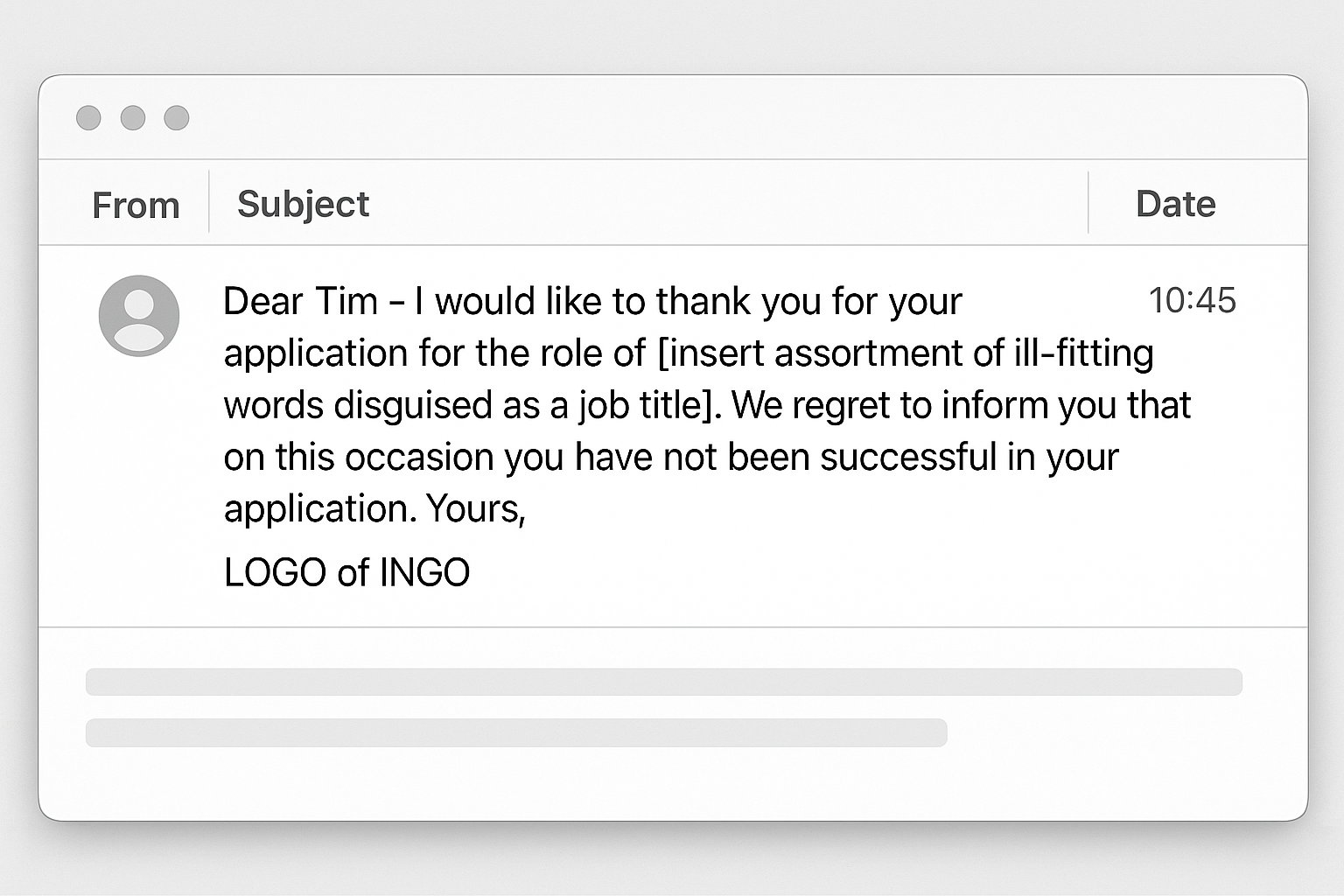
The email above is verbatim from an INGO that rejected me for a “Head of” position. I get emails like these a lot and am comfortable sharing that. It was a rather whimsical application to be fair, given the last six years I’ve been in the market for short term consultancies rather than full-time roles.

However, even with my freelancing I’ve probably only struck gold three times, after spending hours crafting pitches to advertised assignments. Ironically, the most lucrative of those was also the most haphazard application I submitted – a lesson in randomness, if ever there was one.

Most of my consultancy work comes through word of mouth. For that, I’m sincerely grateful. I intend to keep going, not least because my track record with formal applications suggests remaining solo may be wise.

It makes me wonder: is there really no better way for organisations to find people than the tired ritual of CVs and cover letters?

I write this, of course, while still mildly irked by that latest “thanks, but no thanks” email above – copied and pasted as it so often is in the first person, yet unsigned at the end, it felt like a passive-aggressive ghost of correspondence, glaring at me in my in-box.

As this isn’t the first, nor the last, rejection I’ll receive, I did want to share some of the inadequacies I see in the overall recruiting paradigm we have to wade through in the development sector.

Standing Out in the Crowd

Firstly, and as usual, I have no idea what part of my application failed the test, based on the email sent. Was it tone? Experience? Am I too old? Too informal? Should I have omitted my perfectly reasonable demand for sixty days of annual leave and a 25% pay rise each year?

Certainly one can ask for feedback, but some rejection emails even come with disclosures like this other one I received:

“Due to the number of applications received and reviewed, I am not able to give individual feedback at this time, though I do encourage you to consider and apply for one of our consultancy opportunities in future.”

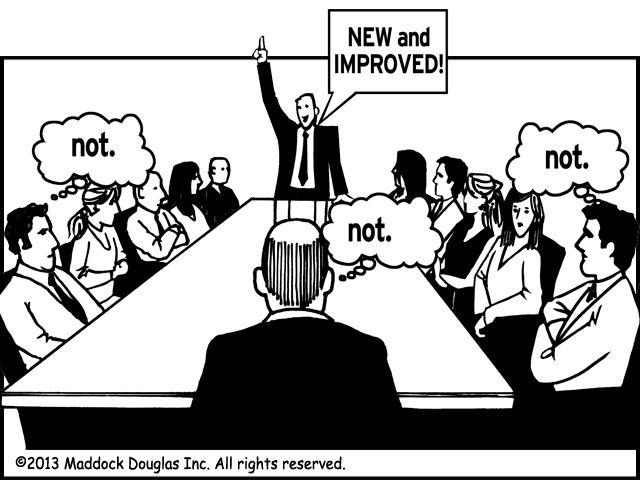
Recruiters tell me the challenge now is volume. Every LinkedIn posting draws hundreds of applicants within hours. Many are AI-generated, indistinguishable from spam. In that flood, it’s little wonder HR teams can’t respond personally. The process has become automated compassion. Efficient, yet entirely devoid of empathy.

And sometimes the role was never really open at all. The ad is window-dressing for an internal appointment already made before your polite rejection hits your inbox. Everyone knows this game.

The Human Touch

When I was recruiting for CARE in London twenty years ago, the process felt clunky, but sincere. Applications came by post, HR filtered the pile, and you spent a weekend reading twenty or thirty of them, scoring each against the criteria. You’d imagine who these people might be, wonder how they’d fit, and inevitably be surprised when you met them.

“He’s nothing like I thought he would be,” we’d gush after the first interview, perhaps a tad disappointed. Then the second candidate would arrive, and we’d instantly revise our judgment of the first.

I want to be careful here, harking back to these times and to any over-reliance on the in-person interview. There’s a strong argument that you’d be just as well to flip a coin, rather than judge two candidates battling it out in 45-minute interviews. I’ve seen plenty of people ace their interview but then turn out to be terrible at their jobs – and vice versa.

That said, while my old team’s deliberations about candidates could be chaotic and subjective, at the same time they were undeniably human deliberations. We’d agree, disagree, wind each other up, have a laugh about it all, and then take a punt on someone. It was a messy chemistry of people trying to imagine other people in their world.

While an interview is only one piece of the puzzle, I hope these deliberations still play out in some teams because it feels instead now that many just outsource that time and imagination to algorithms. Which results in extra pressure on candidates to hit the right keywords, and on recruiters to do the same with the right filters. I think the combination of which can mean people, at times, feel unseen.

Technology was meant to create fairer hiring practices, however I’d argue some of the stuff that used to make it feel more real – the chance for surprise, or for discovery, or for seeing someone as more than a list of verbs and achievements – has been lost as a result.

In Trust We Trust

Truly one of the best litmus tests for success here is trust. Someone who’s seen you work, who believes in you, or introduces you to someone else – that format can work really well, and is devoid of an algorithm and a cover letter. This way of doing things is also, clearly, not comprehensive enough of a format on its own to work for everyone.

There likely isn’t one silver bullet that comes close to solving the dilemma of how to best fill all the roles out there, and all the needs. We will have to use the internet to advertise. I just think our systems for doing so have taken out some of the vital aspects of what used to be there. CVs written by ChatGPT, and rejections by chatbots – where do we go from here?

Perhaps the future of hiring is more about a ten-minute audio pitch instead of a cover letter? Have any organisations out there experimented with short paid trials? Or could claim they host interviews where candidates ask as many questions as they do as recruiters? I’d love to hear from anyone on this.

For me, anything that reintroduces more elements of curiosity, risk and humanity into the exchange would be refreshing.

Too Distracted Scrolling to Notice We’re Sinking

In 2025, the world feels perpetually distracted. Elections, wars, AI, celebrity scandals — global attention ricochets between urgency and noise. Today it’s one crisis, tomorrow another. And we all scroll on.

And yet, a slower, more existential threat escalates beneath it all: climate change.

Especially in Southeast Asia, the impacts are already reshaping daily life. I’m guilty of tuning out, and I know many others do the same head-in-the-sand routine when they skim stories about rising temperatures or shrinking icebergs.

If climate change is so serious then why aren’t we acting like it is?

Southeast Asia is on the frontlines of climate risk. Jakarta is sinking by as much as 17 centimetres a year, one of the fastest rates in the world. In Vietnam, over 50% of the Mekong Delta’s land area is projected to face saltwater intrusion by 2050, threatening not just agriculture, but the food security of tens of millions.

Saline intrusion is already choking rice production in the Delta, while intensifying heatwaves and droughts disrupt water supplies. When these come, droughts disrupt water supplies, and you don’t have to be studying GCSE geography like my daughter (who knows more about this than I) to appreciate what then transpires from a biodiversity perspective: that everything is gradually disappearing.

The IPCC (our collective authority on the matter) warns the window to avoid catastrophic change is ‘brief and rapidly closing.’ That’s not hyperbole — it’s scientific consensus. And, still, climate continues to feel like a background hum, rather than breaking news.

The private sector must play a more central role to Southeast Asia’s adaptation and resilience efforts. Governments alone can’t foot the bill or engineer every innovation. Yet, despite growing interest in green investments and carbon markets, engagement remains patchy.

Vietnam’s 2025 Carbon Market Forum and the P4G Summit were welcome steps. These meetings offered the usual fare: policy frameworks, optimistic keynotes, and lots of “roadmaps.” But translating these into real action remains a challenge.

I’ve worked for a long time promoting sustainability and, in particular, getting business to the table however, let’s be honest, when it comes to climate change, aside from a few regional giants and climate-conscious smaller businesses, most private sector entities are still unsure what climate action means for them, or how to act without sacrificing profitability.

So, I think my call to action on this would, ideally, be quite broad (the ownership of the issue should be everyone’s) however it is here is where I think international NGOs (like my former employer CARE) should step in — not as saviours, but as agencies that can help shape the systems that exist within the private sector, and which relate to climate change.

CARE doesn’t treat women’s empowerment and climate action as separate goals. Instead, they have developed programmes that integrate them through market-based, locally led interventions, tackling environmental threats and economic inequality at once.

In Vietnam, for example, HerGreenVenture supports women-led enterprises with training and green finance to adopt low-emission farming and scale sustainable technologies. In Cambodia, CARE also runs community recycling programmes that help women turn waste into income and reduce landfill pollution. And in Thailand, CARE’s eco-tourism projects led by women are creating jobs while preserving forests and coastlines.

What links these diverse initiatives is a belief that resilience is built from the bottom up.

CARE’s core strategy is clear: gender equality isn’t a side note, it’s central. Women, particularly in rural and informal economies, often bear the worst climate shocks while themselves holding the keys to adaptation. Give them access to green finance, leadership roles, and supply chains, and resilience becomes lasting.

We’ve been warned for years, but action has lagged far behind awareness. Climate experts might point to progress — but, from where I sit, I don’t see enough.

If you’re a business leader, why not starting by asking: how is your company contributing to climate adaptation today? Not just ESG compliance, but to real-world impact.

If you’re in government, how about checking the extent to which you are creating the right conditions for innovation, for inclusion, and ultimately for scale?

And, if you’re an INGO or donor, let’s have more discussion about whether you are building systems or simply just running programmes?

We may live in distracted times. I find myself fighting this day-on-day myself. But, distraction doesn’t make the climate crisis less real — if anything it just makes it less seen.

The question is no longer if it’s serious. It’s whether we’ll start acting like it.

Turn Debt into Hope

https://walletgenius.com/loans/why-debt-relief-plans-might-be-better-than-debt-consolidation/

Do you remember much about what you were doing twenty five years ago? Maybe you can recall how you spent that final New Year’s Eve of the 20th century?

Fun fact, that specific NYE, with only an hour left until midnight, I found myself responsible for introducing an old school friend to the woman who turned out to become the love of his life.

Anyway, while some of us were downing drinks and match-making at a bar in South West London, others were galvanizing global attention about world debt, and its impacts on least developed nations. The Jubilee 2000 movement led that charge at the time, their efforts leading to the cancellation of over $130 billion in debt for 36 countries.

A monumental effort which enabled nations to redirect funds toward critical sectors like health and education, offering millions a pathway out of poverty. But, fast forward to 2025, and the call for debt justice still resonates, only things have got worse.

I’ve been working recently with Caritas International, and have come to know about the launch of their “Turn Debt into Hope” campaign, urging the cancellation of unjust and unsustainable debts that, to quote from their website, “hinder nations from investing in their futures.”

From some quick research it seems that, back in 2000, the total external debt for the world’s Least Developed Countries (LDCs) was approximately $150.4 billion. External debt today, for the 31 poorest, high-risk countries, has now topped $200 billion. We’re seeing the highest burden of debt in 30 years.

​This increase means that even more substantial chunks of money from the world’s poorest governments are being diverted away from public sector needs and, instead, allocated to repaying these debts.

When you then consider other ‘crises’ that encroach upon a country’s economy – be it the slow onset ramifications of conflict, or the rapid emergency of an earthquake (much like the one Myanmar experienced a week ago) – it becomes impossible to see how these debts will ever be repaid.

In the aftermath of a crisis, economies dive, job losses occur, inflation prices scupper spending, and a whole myriad of other economic outcomes conspire to spiral a country out of all control.

Waking up this morning to the news of Donald Trump’s sweeping tariffs (which includes a 10% baseline on all imports, and higher rates on key trading partners such as China (34%), the EU (20%) and a whopping 46% here in Vietnam) it is obvious these escalating trade tensions will only lead to market volatility, to fears of a global economic slowdown, and the inevitably unequal impacts of that on so many of the world’s developing countries.

It’s a brutal, cruel economic conundrum, because it is the most vulnerable communities who face the highest threats.

As I’ve been prone to highlight here many times before now, I believe the role of the private sector to be key in these debates. And yet, too often, these conversations happen without the private sector in the room.

That needs to change. Companies are increasingly recognizing that their long-term success is intertwined with the well-being of the communities in which they operate. Engaging with initiatives that promote economic justice, such as “Turn Debt into Hope”, aligns with corporate commitments to Diversity, Equity, and Inclusion (DEI).

By advocating for, and participating in, debt cancellation measures, businesses can play a role in contributing to the creation of more stable and equitable global markets. All of which, ultimately, benefits everyone.

Twenty five years ago, the Millennium Development Goals (MDGs) set out a charter, with a fifteen year timeframe. The MDGs sewed into their narrative this inference about partnership and the role of the private sector, however it’s been a slow process to bring business to the table.

Genuine collaboration takes time, and today we need to keep banging this same drum, hoist up this same flag, and loudly promote why multi-stakeholder collaboration, that includes business, can be instrumental in addressing both immediate financial injustices, while also laying the groundwork for sustainable development.​

The principles that the 2000 Jubilee Campaign champion are more pertinent than ever. We’re experiencing an era marked by economic uncertainty, by geopolitical tensions, and by ongoing climate crises. Debt cancellation is a crucial lever for promoting stability and prosperity, and we cannot wait another quarter of a decade for action in this space.

The children of my old school friend, who met his future wife on New Year’s Eve in 2000, are already in their twenties. Theirs is the generation now grappling with the implications of a world that procrastinated over its responsibilities.

Do please consider donating to any of the organisations currently providing humanitarian assistance to communities in Myanmar affected by the earthquake – here is one.

Private Sector Engagement in Southeast Asia: The Moment for Bold Action

For fourteen years, as long as I’ve lived in Saigon, I’ve been blogging about ‘Private Sector Engagement’ – its evolution, its setbacks, and its vast potential to drive social and economic change. Time and again, I’ve emphasized one thing: alliances with business are not just beneficial, they are essential.

Yet, at a time when global companies are facing political pressure to roll back Diversity, Equity, and Inclusion (DEI) programs, there’s a real risk that corporate commitments to broader social impact (including sustainability, worker rights, and responsible business practices) could be deprioritized or abandoned altogether.

With government funding for aid shrinking fast, the question is no longer whether the private sector should play a role in sustainable development – but how fast we can make that happen? Companies must resist the temptation to step away from ESG (Environmental, Social and Governance) commitments, or drop impact-driven business models. Instead, they must double down on sustainable, long-term strategies that create both profit and positive change.

Rather than dwelling on the alarming consequences of these funding cuts (which many commentators are documenting well), I want to underscore why this moment demands a shift.

From my work in sustainability consulting, business partnerships, and initiatives with CARE, I’ve identified the following key trends shaping this transformation.

The Rise of Impact-Driven Partnerships

Corporate Social Responsibility (CSR) in Southeast Asia has long been philanthropy-driven, with companies donating to social causes without embedding impact into their core business. That’s shifting.

While there’s still a place for sponsorships, more businesses now see the value in long-term, strategic partnerships with NGOs and social enterprises. CARE has always been my “go-to” on this, for examples of the innovations used to secure “win-win” partnerships with corporations – I’ve listed their collaborations over the years with the likes of Barclays, Allianz and GSK as just a few examples.

In Southeast Asia, many other organisations have worked collaboratively with companies. World Vision & Procter & Gamble in the Philippines, for example, ran a Hope in Garbage project, which collected 3.2 million plastic sachets and 870,000 plastic bottles, upcycling them into 1,040 chairs for schools – a great model for sustainability and education impact.

Here in Vietnam, The East Meets West Foundation, also known as ‘Thrive Networks’, partnered with GE Healthcare to enhance healthcare infrastructure leading to the development of medical institutions, and the provision of custom-designed equipment to hospitals, aimed at improving neonatal care and reducing infant mortality rates. ​

Even in industries like apparel, where brands once relied on short-term worker welfare programs, we now see the co-development of ethical supply chains with sustainability organizations. CARE and the ILO’s early 2000s work laid a lot of the foundations for this, and entities now, such as RISE, are pushing ethical supply chain development even further as result.

Where to from here? To me, the answer is clear. Organizations – NGOs, especially – engaging with the private sector need to move beyond sponsorship requests and, instead, position themselves as strategic partners that bring business value, through such things as innovation, market access, or risk mitigation.

The Shift from Compliance to ESG-Driven Business Models

ESG factors are becoming a competitive advantage, rather than a regulatory burden. Investors, consumers, and governments are increasingly pressuring businesses to embed sustainability into their operations. The result of which is that large corporations are developing ESG frameworks, not just to comply with regulations, but to attract investors and gain consumer trust.

And with this trend, we are seeing multinationals now pushing sustainability requirements down their supply chains, impacting SMEs and local businesses.

Governments in our region are also starting to integrate ESG into investment policies and corporate reporting frameworks. Both Vietnam and Indonesia, for example, highlight ESG in financial reporting, investment strategies, and regulatory frameworks.

Vietnam even has a “report or explain” framework and Corporate Governance Code which both promote transparency, while Indonesia’s OJK Regulation No. 51/2017 mandates ESG disclosure for listed companies.

As ESG gains traction, the non-profit world can play a more prominent role in ensuring businesses go beyond compliance to create real social and environmental impact. NGOs can add value by training smaller companies on ESG compliance, reporting, and sustainable business models, and also facilitating partnerships that ensure corporate ESG aligns with local needs. There is also room for NGOs to play a role in accountability, monitoring ESG commitments, preventing greenwashing, and pushing for stronger corporate governance.

The Growth of Market-Based Solutions & Inclusive Business Models

Lastly, one of the most exciting trends I think Southeast Asia is experiencing, is the rise of businesses integrating social impact into their core revenue models. Rather than treating sustainability as a cost center, companies are developing commercially viable solutions that also drive impact.

As such “circular economy” models are emerging, particularly in sectors like textiles, packaging, and agriculture. Whilst social enterprises are scaling through corporate partnerships, blending business growth with community impact.

I saw this firsthand as early as 2007, when I worked on CARE’s rural sales initiative in Bangladesh – a project that later spun off as JITA, itself a stand-alone social enterprise in 2012. Since then, the region has only expanded its approach, with more companies exploring inclusive business models that drive both profit and impact.

These ventures, requiring businesses to engage with underserved communities, need cross-sector expertise, opening up opportunities for collaboration between the private sector, NGOs, and impact investors. Organizations that can align their business goals with market-based impact solutions will, in my opinion, have a stronger case for funding and growth partnerships.

Where to Next?

Private sector engagement in Southeast Asia is no longer an option in my view – it’s a necessity. With aid funding brutally slashed, ESG becoming mainstream, and political pressure mounting against corporate social commitments, businesses and impact organizations must collaborate in smarter, more strategic ways.

In the face of backlash against DEI, we must recognize that ESG, sustainability, and inclusive business aren’t just about good optics – they are about long-term business resilience, risk management, and innovation.

Businesses should move beyond compliance and integrate ESG and impact into their core strategy, rather than retreating from it. Whilst NGOs must stop just chasing sponsorships and become strategic partners that offer value.

The opportunity is there for the taking. The question is: who’s ready to lead, and who will fall behind?

What next after CSR?

Subscribe to continue reading

Subscribe to get access to the rest of this post and other subscriber-only content.

Closing the digital divide in Czechia

Plastenco, Czechia. Photo credit: CARE Czechia.

On 31 December 1992, Czechoslovakia was dissolved, with its constituent states becoming the independent states of the Czech Republic and Slovakia. Thirty one years later, and the Czech Republic (known as Czechia) and Slovakia rest at #35 and #42, respectively, on today’s GDP list of ranked country’s (based on IMF’s gross domestic product scores).

It won’t surprise the loyal readers of this blog (all three of them) to hear that I’ve not become an overnight economic boffin. Instead, I wanted to share some thoughts about Czechia and, more specifically, STRIVE Czechia, an initiative I’m working on, which supports small businesses in a country that I knew very little about, until now.

Whilst GDP calculations are not typically an accurate picture of personal earnings, these rankings suggest that individual annual earnings in Czechia and Slovakia are in the ballpark of $31,000 and $23,000.

For comparison’s sake, the UK is ranked at #22 with $46,000, and Burundi is at #192 with $249 (which seems too low to be correct, but I’m not the IMF).

I’ve visited Czechia’s capital, Prague, a few times, first in the late 1990’s, and subsequently in the early 2000’s, and I remember it being a very easy city to get to grips with.

Literally being the part of the world from which the concept of “bohemian” originated, the blend of old and new, of traditional and modern, the city’s architecture, its stylish sweep of cafe-lined streets, cobblestone bridges, sculpted lampposts and spires, the wafts of wine-soaked stews coating the senses – all of these things and more (the beer, for starters!) left indelible watermarks on the memory of my formative years, stepping out and into new adventures.

The countryside, I recall, was like a framed antique painting: colourfully etched, and stuck somewhat in time. Long, empty lanes scoring through forests. Wide open blue skies.

After a dozen years living in Saigon, drinking in these memories is a mental tonic, to the daily cauldron of heat and vapors that epitomizes urban Asia.

Anyway, nostalgia relived. To business. Small business, to be more specific.  

STRIVE Czechia: Helping small entrepreneurs grow and succeed in the global digital economy

STRIVE Czechia is a three-year initiative, run by CARE Czechia, and supported by Mastercard, plus an array of partner entities.

And STRIVE is on a mission quite unlike a CARE International programme of old. Why? Because it is not the poorest, or most vulnerable population groups in the country that STRIVE is solely targeting (a criteria that CARE, for many decades, held up as key).

Rather, this work is about economic gains on a macro level, and it is about growing and advancing the country’s private sector.

As a CARE initiative, STRIVE is focused on MSEs (micro and small enterprises) run by women – it hopes to reach 100,000 women run MSEs, out of a total of 250,000 – but it also has ambitions to support at least 10,000 MSEs led, or owned, by displaced Ukrainian entrepreneurs.

STRIVE’s goals are to positively influence the development of the country’s MSEs because, collectively, they make up 99% of Czechia’s economy, and provide employment for 67% of the country’s population. It is MSEs on whom the Government is reliant, when it comes to inching Czechia higher up in next year’s IMF rankings.

Economic gains made by MSEs will support the wider communities and citizens of Czechia. Economic gains made by MSEs will open up opportunities for young people, as well as those more disadvantaged for various reasons.

A core part for the programme is helping MSEs access and benefit from digitalization, given the current situation in the country, whereby low numbers of MSEs are fully benefiting from digitalization, and where many also lack the necessary proficiencies to utilize digital tools and financial products.

Many also don’t have connectivity with peer networks and face the challenges (as most small businesses do) of juggling responsibilities of work and home life. A dynamic that is of particular resonance for women, given the social norms that place them, over men, in positions of responsibility in the household – the systemic “duty of care” that, the world over, prevents women from advancing at the same pace as men, in terms of earning income and having control over resources.

Whilst the modality of how STRIVE is seeking to intervene in Czechia might, on the surface, seem different to how “development” programmes have in the past been delivered (ie targeting the poorest communities) CARE is not new to engaging MSEs, nor to working in partnership with the private sector to do so.

CARE’s IGNITE programme, here in Vietnam: photo credit CARE International

I’ve written continuously about CARE’s collaborations with business for over ten years now, and the tie-up with Mastercard is fast becoming one of the confederation’s signature partnerships.

As part of CARE’s global commitment to support female entrepreneurs, they have already delivered some fantastic outcomes for entrepreneurs in Vietnam, Peru and Pakistan, as part of the IGNITE Programme – an initiative also supported by Mastercard and seeking to close the digital divide for female entrepreneurs.

CARE’s experience in “financial inclusion” (finding ways of reaching the many millions of people cut off from formal financial services) is deep-rooted and has evolved over the past thirty years.

Bringing some of the world’s largest financiers to the table as part of that, has been essential.

The “Banking on Change” partnership (circa. 2009) between CARE, Plan and Barclays was a watershed moment, both for operationally linking up local savings groups to formal structures, and then for how this partnership lobbied, at an institutional level, for a more unilateral banking “Charter” – supported by the World Economic Forum at the time and influencing multiple other business industries.

Not unsurprisingly, in 2014, Mastercard signed up to the Linking for Change Savings Charter (to give it its full title back then) and have continued to promote linkages, as well as the opportunities that digitalization can bring, in terms of confronting income and wealth inequalities.

***************************************************

Returning to STRIVE Czechia, I look forward to sharing more over the summer, as the second year of activities rolls out, including: the creation of a ‘One-Stop Shop’ facility for MSEs to leverage digital and financial resources; and launching further deep-dive research into the challenges and opportunities encountered by Czechian MSEs. All of which will serve to fine-tune how STRIVE best supports the country’s private sector in the future.

Many of the MSEs already engaged in STRIVE speak of the benefits they’ve accessed from the programme. Plastenco (featured in the youtube clip, below) is a sustainable design MSE, and one of the first wave businesses to collaborate with the STRIVE team – sharing their needs, and optimizing the space that STRIVE is holding for open dialogue between private, public, civil society and academia in Czechia (STRIVE is in discussions with the Academy of Sciences currently, to address some of the multi-dimensional issues about gender, mentioned above).

It is through the collaboration with the likes of Plastenco, as well as the combined time and effort of openly engaging other MSEs, that STRIVE can shine a light on just how critical MSEs are to the country’s future economic and social gains.

In closing, and returning to the intricate connection between Czechia and Slovakia, a recent report by the firm sapie, conducted in Slovakia, is worth highlighting, for comparison’s sake to the eco-system inside which STRIVE Czechia is navigating.

To summarize it, Slovak companies – both SMEs and micro-companies – have a “long way to go to close the gap with the digital frontrunners”. As STRIVE has also documented for Czechian MSEs, Slovak entrepreneurs realise the necessity to digitalize, but lack sufficient knowledge, experience and simple financial tools to be able to fully benefit from digitalization.

Raising awareness in Slovakia, the report concludes, about the benefits of harnessing digital tools and platforms, and demonstrating how such tools can help small businesses to “survive, save money, save time, at least retain their position on the market, as well as increase profitability and competitiveness” are perhaps the very cornerstones required in curating a more robust, and enabling, environment for small businesses and enterprises to function.

This needn’t be very different in Czechia, for MSEs. Each country shares similar economic characteristics and societal constructs.

And it is this, and these areas, around which STRIVE – in partnership with others – will concentrate all of its assets and resources going forward.

So, watch this space!

Czechia countryside. Photo credit: https://suwalls.com/nature/path-through-the-grass-to-the-lake

Stuck in our ways

Gaza, 2017. Photo credit: Tim Bishop

I read two things last week, coincidentally connected.

The first was a report from CARE International, offering insights about the impact COVID-19 has had on the local community groups that CARE has been seeking to support for decades.

I commend this report to anyone with an interest in the topic of international development. The analysis is rigorous, yet the recommendations are simple. The tone is calm, but unsettling, given the evidence being shared, which points not to the successes of the international development community, but instead underscores its failures.

It cites how impactful the pandemic has been, in terms of increasing, rather than decreasing, gender inequalities.

It also proposes that far too much potential progress in development is “held back by the deeply colonial approaches” still adopted by global development organisations, including CARE themselves.

Sifting through social media feeds, I then stumbled upon this quote from the novelist and cultural critic, James Baldwin:

“The entire purpose of society is to create a bulwark against the inner and the outer chaos, in order to make life bearable and to keep the human race alive. And it is absolutely inevitable that when a tradition has been evolved, whatever the tradition is, the people, in general, will suppose it to have existed from before the beginning of time and will be most unwilling and indeed unable to conceive of any changes in it. They do not know how they will live without those traditions that have given them their identity. Their reaction, when it is suggested that they can or that they must, is panic… And a higher level of consciousness among the people is the only hope we have, now or in the future, of minimizing human damage.”

Drawing these two “things” together (CARE’s report and Baldwin’s musings) doesn’t take a considerable amount of effort: the traditions to which Baldwin refers, are part of the very reason that international development has failed. The traditions that dictate the colonial influences over how aid has been invested, coupled with the traditions which set the social and cultural constructs that exist on the side of the recipients of that aid, create a perfect storm of incompatibility.

For sure, there are examples of success, and I have spent time on these pages promoting them.

Unfortunately, these are overshadowed by examples of failure, and worse: examples of repeatedly making the same mistakes over and again.

Signing of The Marshall Plan: from http://www.sucesoshistoricos.com

In 1948, the United States committed to the rehabilitation of Western Europe, kicking off the “Marshall Plan” as an investment to help countries after the War.

Many of the recipient countries of the Marshall Plan – Britain, France, Netherlands, Belgium, West Germany and Norway – had, themselves, previous experience of providing aid to countries years before.

Foreign assistance, as a concept, had been around since the 18th century. However, since that time, the majority of the assistance given was from countries such as Britain and France, and predominantly to their respective colonies.

To recap, hastily, on how development has evolved since 1948, organisations (such as CARE International) have invested significant time and energy trying to understand how to most appropriately and effectively assist those “living in poverty”.

Those last three words are in speech marks, because defining who beneficiaries actually are has, itself, been a 75-year exercise.

The World Bank annually grade country demographics and, historically, many aid organisations and government donors use this guidance to allocate funds. Which is why more recently South American countries and now South East Asian ones, are receiving less “aid” due to how they have slowly climbed the World Bank rankings, moving from “low income” to “medium income” economies.

Using economic indicators such as these, some development agencies have prioritised the “extreme poor” as a target group for receiving aid.

Whilst others have nuanced their criteria for “poverty” and zoomed in on defining groups of people based on how “vulnerable” or “marginalised” they might be, which then takes into account criteria beyond income.

Over time, and as the international development industry has expanded, more types of people in need are included, in some way, by some organisation, or movement.

In any case, whilst they have been undertaking their deep dive analyses, and designing their ever-complex programmes, these organisations have encountered a slew of cultural and social normative behaviours (again, Baldwin’s ‘traditions’ – to which each community they are assisting is bound and, from which each community is so heavily defined.

For CARE, the gendered aspects of such cultural traditions – whereby men typically dominate decision making and hold the majority of power over women (at home, in the workplace, and in public spaces) – has become the lynchpin around which all of CARE’s efforts have been inspired.

For others, UNICEF or Plan International, for example, their research and development has anchored itself to the challenges that children or young people, respectively, face in society.

As many commentators have cited, the evolution of “aid” over the last 200 years has charted a meandering course, undergoing regular modifications.

Take the topic of financing, for example.

Many nations, and large development organisations, have explored what might be the most efficient financial instruments they can deploy: Government-to-Government loans; microfinance programmes; economic stimulus packages; public-private funded initiatives, designed to strengthen economies and improve societal issues.

Each of these examples, come with their own success stories however, without exception, each encountered this same obstacle of tradition on both sides of the equation: the traditional norms set by those investing funds and resources into development, and the traditional norms played out by those receiving the financial “help”.

Given these constraints, it is simply not clear, even today, what types of interventions are best and how these should be delivered.

Is it more appropriate, for example, to stimulate economic growth for a country or, instead, better to understand upfront what is needed by those in that country who are struggling financially and who are excluded from formal systems (ie they lack access to bank accounts, internet, markets, education, etc) and to design an intervention that addresses that need?

Both of these approaches have been tried and tested and, in some cases, combined. However, again, traditional norms create obstacles along the way.

For example, direct budgetary support (a financial transaction between Governments) was, for a while, a popular choice of many richer nations to financially support poorer ones. Yet, this type of support could be all too often undermined by recipient Governments not properly distributing the funds through public services. Instead, many would funnel disproportionate amounts into other areas, such as to the bank accounts of Government officials.

And, when it comes to implementing the second approach (ie answering the “needs” question) this, too, can be compromised by the nature of who makes decisions in society, writ large.

Not exclusively, but typically, all such development-based transactions, and development-based relationships in the past were led by men.

The result of which is that less consideration, over seven decades of international development, has categorically been attributed to those societal issues that would have been selected by women. Women simply haven’t had the opportunity to have an equal voice in conversations about international development in that time. Not in the initial orchestration of The Marshall Plan, nor in the decisions with, and within, communities in terms of where and how the resources should be utilised.

It was CARE who established the first ever Village Savings and Loans Association (VSLA) in Niger in 1991, a mechanism for women to save and loan money with one another.

This, in turn, inspired the scale up of VSLA platforms around the world, adopted by other organisations too, encouraging women to have a voice inside of communities, and ultimately enabling women to speak out and influence local structures and systems.

VSLAs are one example of how this acutely gendered dynamic and imbalance is shifting. Unfortunately, the pace of change is slow.

Take the issue of unpaid care. This remains a pertinent topic even in the most “progressive” of societies. In the world of business, equal pay and worker benefits are also not yet level for all employees. For many nations, their politicians and leaders have been, and in many cases remain to be, male dominated. As of 2021, only 1 in 5 ministerial positions globally were held by women and, even today, just 17 countries have a woman Head of State, and 19 countries have a woman Head of Government.

These stark ratios are reflected, too, at the local level of the majority of countries – in the political and public spaces of local authorities and community leaders, in small to medium enterprises and local businesses. The patterns are similar, the outcomes the same.

And, whilst today’s inter-connected world has increasingly called out these gender imbalances, in a way that simply wasn’t viable even 20 years ago, Baldwin’s intuition when he writes “They do not know how they will live without those traditions that have given them their identity” rings true.

Just as traditional norms hold back gender equality, so too do they stifle advancements made around other forms of inequality.

More than ever, we have been made aware of the economic inequalities of the world – the “1%” phenomenon.

Every country maintains its own version of this and, globally, it would seem that the ratios of the ‘haves’ and the ‘have nots’ become ever more extreme with each annual set of data released.

According to last year’s World Inequality Report, “Global wealth inequalities are even more pronounced than income inequalities. The poorest half of the global population barely owns any wealth at all, possessing just 2% of the total. In contrast, the richest 10% of the global population own 76% of all wealth.”

Armed with such data, it is hard not to side with those campaigning for change. Be that from an accountability perspective, lobbying for more responsible policies and practices adopted by business and by government institutions. Or be it from a more ethical perspective, targeting individual behaviours.

Both make sense, yet both have their limitations when it comes to just how much ground individuals, corporations, or governments, are prepared to concede at their own expense.

***********************************************************

With power comes responsibility, and all too often that responsibility lies in the shadow of a tradition that is extremely hard to change.

Whether you set your sights on tackling inequality, poverty, vulnerability, marginalisation, gender equity, disability, child rights, or other such societal issues, I would argue that Baldwin’s plea for a “higher level of consciousness” remains, simultaneously, a sobering as well as a viable salvation, when redressing some sort of balance in the world.

Although I was tempted to end this post conceding that Baldwin’s call to action might never be fulfilled, instead I would suggest that the subject of ‘consciousness’ gains more traction with each generation.

What if we kept a higher level of consciousness close to heart, and nurtured that sense of what it can mean each day? What if we tried to imbue Baldwin’s words and sentiment into as many interactions, thoughts, exchanges and relationships that we could accommodate?

Do this, and perhaps there may yet come a time where our connectivity with one another sets in train a new sense of what tradition is, what it stands for, and what new outcomes it might reveal.

Placing the future of ‘Partnerships’ in the best hands

A new dawn for partnerships – Bangkok, March 2023

Last week I co-facilitated a training course for UNESCAP (the UN’s Economic and Social Commission for Asia and the Pacific) at the UN headquarters in Bangkok.

This is noteworthy (and the cause of my first post here since May last year) largely because it represents only the second overseas trip I’ve made for work, since I high tailed it out of Laos in March 2020, with hours to spare, before the Vietnamese border police would have had me detained for a fortnight.

Whilst narrowly avoiding being barred for tampering with UN tech equipment in our set up last week (as well as encountering a curious number of delegates who tried to infiltrate our course) the days spent with the 20 participants enrolled on the training was a real privilege, and a further reason for sharing some reflections here.

The course itself – The Partnering Initiative (TPI) Partnership Accelerator – was a distilled version of a longer set of modules that I’d been conducting online, during the pandemic, as an associate of TPI. In engaging previous teams in the content, from international NGOs, through to large corporations, and UN agencies themselves, I’ve come to acknowledge that TPI’s curriculum offers up a comprehensive and water-tight set of insights and tools, to equip most would-be partnership experts out there looking to forge, manage and scale up multi-stakeholder initiatives and collaborations.

Built into our sessions in Bangkok was more than a smattering of theory and frameworks, about how to get the best out of your partnerships, alongside practical exercises and role plays, designed to allow teams to practice such things as negotiation skills, trust building, and experiencing alternative power dynamics.

Last week’s participants had gone through a lengthy application process in order to participate and then, in most cases, had also gone through lengthy journeys from various SIDS (Small Island Development States) in order to physically show up in Thailand.

Fiji, Mauritius, Seychelles, Palau, Kiribati, New Caledonia, Solomon Islands, Papua New Guinea and Timor-Leste were all represented in some form, during our two days – a constellation of countries covering some of the planet’s most diverse and distributed societal eco-systems.

There are 58 SIDS in total, and one of the resounding pieces of encouragement, that I took away from those engaged in last week’s training, was the appetite and energies they told us their country’s young people felt about the array of sustainability issues that the UN, and others, have carved out across the existing SDGs (Sustainable Development Goals).

I was struck not just by the talent and inputs and experiences shared in the room during our course, but by how motivated each participant was to take their knowledge and learning from the course back to their home countries and to disseminate this wider.

Young people, it was made clear, either still studying, or launching their careers in SIDS, hold the key, in so many ways, to unlocking and unleashing the real power that true partnership-working possesses, when it comes to addressing the world’s most pertinent of social and environmental crises.

All too often, cultural and historical norms predominantly practiced by older generations, hold back progress in society. Progress, for example, towards enabling more girls to have access to education. Progress towards offering more inclusive opportunities for local communities to benefit from national and international supply chains. Towards a future where land rights are equally distributed and acknowledged, where political spaces incorporate more voices from those all too often marginalised, where the resources and the influence of the private sector are leveraged in a more equitable way, namely one which benefits the world’s informal economies.

These outcomes, and many more, were the talk of our sessions in Bangkok, and these issues deserve more airtime beyond a brief training course.

From our participants last week we heard that these are issues which should be built more rigorously into school curricula. Their importance is such that we cannot rely on those in current positions of power, set as they often are in their own ways, and blinkered to emerging societal trends, to be the “changemakers” or the “catalysts of change” that they so often label themselves.

It is young people, either of school or university age, or of working age, with whom these issues most resonate.

Tomorrow’s leaders will carry the can for many of the mistakes made since the concept of “partnership” was broadly incorporated into development jargon. Some people in development circles will say partnerships have always been around, but it was, perhaps, only really at the UN’s 1992 Rio Conference on Environment and Development that the concept of multi-stakeholder partnerships was first coined in a serious way.

In the 30 years since, we’ve seen some admirable attempts to model partnership working. However, we’re just skimming the surface of what I believe can be achieved.

TPI have been hard at it, consulting, designing, sharing and teaching thousands of practitioners since they took on this gauntlet almost 20 years ago. I admire them for that, and for what they have carved out in this space. They are leading the charge.

It is, however, in the hands of the younger generation, in my opinion, where we should be increasingly targeting investments, resources and opportunities to build even wider and deeper the ‘know-how’ about what partnering can achieve, and how it can be done even better. And, on a scale that we’ve never seen before.

Understanding CARE’s Resilient Market Systems work

In the international development sector, it’s commonplace to read about “systems change”. This is a broad objective. There are many different types of systems in the world, and many ways to change them. There’s a system for how banks distribute money, and how utility companies manage the flow of clean water to households. A system for how to hold your government to account on social welfare measures. A system, more culturally nuanced, for how families inherit assets. A system for addressing global health pandemics. And so on. Millions of systems and ways to both disrupt them and to improve them.

Typically, the INGO industry champions those citizens directly facing marginalisation, vulnerability and injustice.  At CARE International, where I spent thirteen years, the target group supported are women and girls. One particular area of focus that I worked on was how to bring the potential of businesses and markets to bear, for the women and girls CARE sought to assist. Many of you have been subjected to years of my posting here, on related experiences from this starting objective. For which I am most grateful.

Having recently completed a consulting assignment with a very special CARE team, based in Palestine, we’ve published a ‘Compendium‘ for those practitioners in the sector who are looking at systems change in the context of fragility and crisis. Better still, for practitioners who are also advancing their engagement with the private sector and their women’s economic development efforts.

The Compendium is titled “Resilient Market Systems” because its goal is to influence not just the economic opportunities for women and girls (enhancing their resilience to economic fluctuations) who are faced with crisis situations, but to improve the resiliency of the wider market systems, themselves impacted by the same crisis.

2020 has also produced Covid-19, a merciless ‘crisis’ that has touched the lives of everyone, and which calls for organisations to pull together. Enabling more ‘resilient market systems’ is clearly not an overnight project, nor something that CARE can do without collaborating with others. However, as a global confederation with a strong cadre of practitioners working in some of the world’s most complex crisis contexts, just aligning CARE’s own teams can be a challenge in itself.

In many ways, this Compendium is a call to action to us all to think about our own role in the market systems within which we operate.

What is a market system? Well, at the heart a market system (captured in the schematic below) exists goods and services value chains, running from production to consumption, and linking up national, regional and global markets. From essential services (eg banking or health) to the production of a range of consumable goods, the roles of the many stakeholders that participate in this chain, who are affected by each of the various external environmental, political and societal influences, are all inter-related.

RMS model vers2

CARE’s work sets out to trigger a range of improvements that make crisis affected market systems more resilient, inclusive, and profitable in such a way that addresses the previous inequalities which prevented women from benefiting from markets on the same footing as men.

The Compendium aims to help practitioners think through how to do this. From the type of analysis at the beginning of planning the work, through to considerations of how the work will transform gender dynamics favourably for women, to the ways in which the private sector can be engaged, through to how to test people’s resiliency to dynamic economic change.

I commend the concepts behind this publication, and the range of experiences and case studies (ten of which are featured in the Annexes) contained inside. Not just for the more technical components to the document, but because of the nature of how the contents and the spirit behind the work was conceived. Drawing from across the Middle East and North Africa region – countries including Palestine, Turkey and the Caucasus featuring prominently – but also wider, this Compendium walks the talk of how a large confederation such as CARE should be working collegiality across its teams, diversifying its thought leadership in the pursuit of the right solutions, for those most in need of them.

Johnson’s DfID merger is sending us back in time – again.

Aside from the plausible accusations that the Government’s merging this week of the Department for International Development (DfID) with the Foreign Office was a “media stunt” to distract away from their U-turn earlier in the day on free school meals, the announcement about DfID was depressingly predictable, and in-step with an administration, yet again, talking about their vision for “change” but acting in ways that only serve to drag the country backwards.

I’ve plenty of disparagement to channel at both Labour and Conservative leaderships over the last 20 years. However, under Claire Short for the first six years of Tony Blair’s Government, in my opinion we experienced a conviction and clarity about the role of DfID that has since to be matched.

Blair’s re-branding and re-positioning of DfID (previously the ‘Overseas Development Administration’) as having full departmental status, complete with a Secretary of State was, in itself, a turning point.

During her tenure, Short had plenty of critics, however a cornerstone outcome of these early years with her at the helm was the Partnership Programme Agreement (PPA). The PPA was a multi-million pound investment from DfID that was used to leverage their relationships with British INGOs (International Non-Government Organisations) – including CARE International, for whom I worked from 2006.

From first hand experience, I saw how effective these funds were for INGOs looking to build the capacities of their teams around the world and, in doing that, mobilising local community based organisations.

The PPA covered Latin America to Sub-Saharan Africa, the Middle East, South and East Asia, all the way to Vanuatu in the Pacific and funding wasn’t “restricted” – the term used by institutional donors which means money is earmarked only to be spent on certain items. Instead, it was more simply a requirement that funds complemented DfID’s priority areas of work – which initially included: conflict and peace building; women’s economic development; governance; and private sector engagement.

Following the Iraq invasion in 2003, and the Asian Tsunami in December 2004 and then, indeed, throughout the period I was based in London (from 2006 to 2011) DfID consistently updated the issues and geographies they felt to be of prime importance.

As DfID’s global coverage was reviewed under Cameron’s team from 2010, offices in Latin America closed first, deemed predominantly a region consisting of “middle-income” status countries and less in need of traditional aid. South East Asia was next (they closed their Vietnam office in 2016) and overall the nature of PPA funding and how it used was dictated by other criteria.

From here on it felt like DfID was re-purposed all over again. Whilst Cameron was committed to DfID receiving and spending 0.7% of GDP (the magical figure to which very few donor countries have aspired) he introduced an annual “value for money” evaluator which held back funds until organisations could prove they had delivered results on the ground.

On the one hand, he was calling out agencies on being more accountable (as well as trying to keep Daily Mail readers charmed for polling days, given the rising outrage propagated by the “Red Tops” about British aid money being sent to countries such as India – a nation with 350 million people living on less than one dollar a day, but also housing a nascent space programme).

On the other hand, it is ludicrous to measure meaningful change taking place in under twelve months. At the time, the previous 7-8 years of PPA funded work was only just on the verge of being able to quantify ways in which programmes had addressed gender norms, let alone to have fully rehabilitated a state such as Tamil Nadu, which had been destroyed during the Tsunami.

And so, in place of a more open, thoughtful and practical distribution of funds, through mechanisms like the PPA, the Tories instead focused on trade issues, on supporting ex-commonwealth countries (in particular Kenya, which hosted regular delegations of Ministers and their wives) and on gradually reducing the amount of money they were prepared to invest in partnerships with INGOs.

I don’t feel qualified to mention the fine balance – always there – with which the British Government has forever had to deal with being one of the largest manufacturers and suppliers of high grade military weapons the world over, whilst at the same time being held up as a beacon of ‘know-how’ when it comes to their work on social injustice, poverty and inequality. Go figure. Perhaps that is for another blog.

What I do know is that, within that complex backdrop, DfID had many very progressive years of designing a new approach, and a more appropriate role for itself and for its international ambassadors, be they individuals or partner organisations.

Johnson and Co. have just rendered that progress irrelevant with this merger. Just as the Australians have done with their previous international development arm, now part of the Department of Foreign Affairs and Trade (DFAT), in the process slashing millions of previously sacred aid money. Not that dissimilar too, to the stance taken by Donald Trump since he took office, and cut the legs off the US Government’s aid department (USAID) budgets.

These power-plays are related. They smack of Governments losing the foresight and the global citizenship credentials required to sit at some of the world’s most important decision making tables.

The DfID merger is sending the UK back in time – a core characteristic of the Johnson administration on many fronts – and it’s a terrible, terrible shame.